It is true that a sparkling kitchen will help to sell a home faster and for more money. A question that comes up occasionally with people thinking of selling their home is Should I renovate the kitchen before I sell my house? I cannot give you a definitive Yes or No answer but I can give you some things to think about regarding your own personal situation.
If you live in an older house that requires a lot of updating or if your house is what is referred to as a “fixer upper” and needs a total renovation, (though some people have a hard time accepting reality about their house) I would suggest not spending the money on the kitchen. It will look out of place if the house requires so much work in other areas. Buyers are savvy and will still notice all the other work that is required. Also, you likely will not recoup the investment you made in your kitchen. New kitchen or not, fixer uppers are a tougher sell.
On the other hand, if you have been keeping other aspects of your house up to date and modern but just have not made it to the kitchen yet, I would consider doing the kitchen. For the same reasons as above about not replacing the kitchen in a fixer upper, an old kitchen will look out of place in an up to date house.
What brought this home to me was when I went to visit past clients who are considering selling. They had bought their house over 20 years ago and have maintained and updated it nicely. Windows, hardwood flooring, shingles, most of the big ticket items. Their house is beautiful. One thing they had not tackled was the kitchen as understandably it can be expensive. It was a good size kitchen but not huge and would not cost a ton of money to install nice modern looking cabinets. It was one of the few times I have suggested putting out the money for a new kitchen. They would easily get their investment back because the rest of the house was in such good shape.
A less costly option is refacing your existing cabinets. There are a few ways to go about this. If your cabinets are the modular type (you know, the ones made out of particle board) you probably will be able to buy new doors to go on your existing cabinets. There are also professionals who will come in and spray paint the cabinets and a third option is to repaint them yourself. This is the cheapest but also the least desirable.
If your kitchen needs to be renovated and you are planning to sell it in a few years, why not do the kitchen sooner rather than later? Your kitchen may not be brand-spanking new after 3-5 years when you are ready to sell but you will have had the use and enjoyment out of it for a few years. And in my opinion that is well worth it.
We've spent a lot of time over the last couple of years talking about declining prices, higher inventory and buyers having more negotiating power.
But we've also seen some signs this year that the market may be starting to stabilize. So what happened in August? Let's take a look.
August was kind of a mixed bag of numbers. The volume of Sales in August dipped after 5 months of increases in 2026.
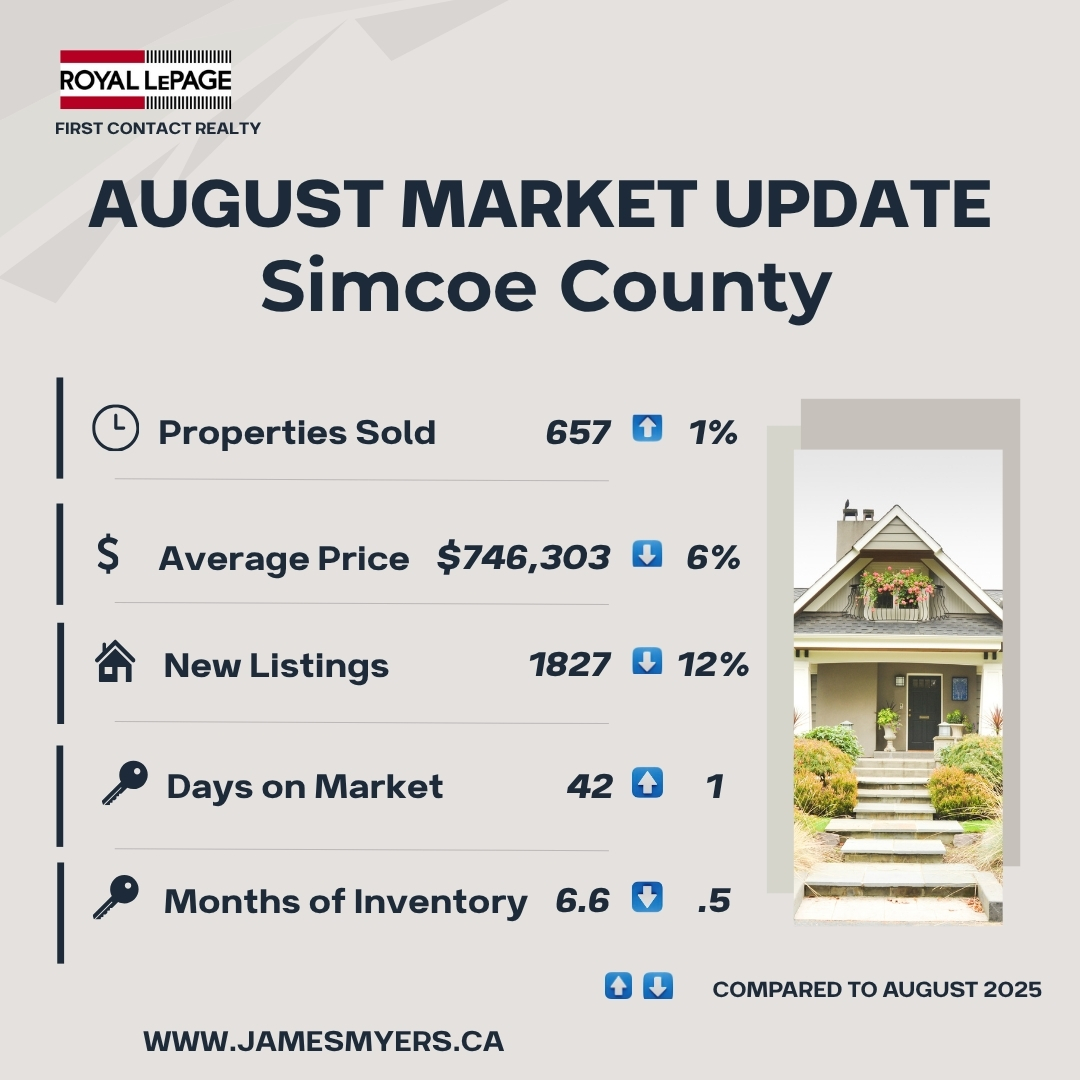
For the most part, the number of new listings has been dropping all year and across Simcoe County new listings coming on the market are down 12 percent. But the number of sales is just down 1%. That difference is something to pay attention to.
August is traditionally a slower month. People are busy trying to cram in the last of the summer activities and selling their house or buying a house doesn’t really register with a lot of people. New listings will pick up in September.
Simcoe County:
Let's start with the big picture. Across Simcoe County, 657 properties sold in August — that's up 1% from last year, so sales held steady. To me, 1% difference is not anything worth paying attention to. Whether it is 1% change in price, number of listings or number of sales. But the average price came down 6% and the number of new listings is off by 12%.
Detached Houses in Barrie:
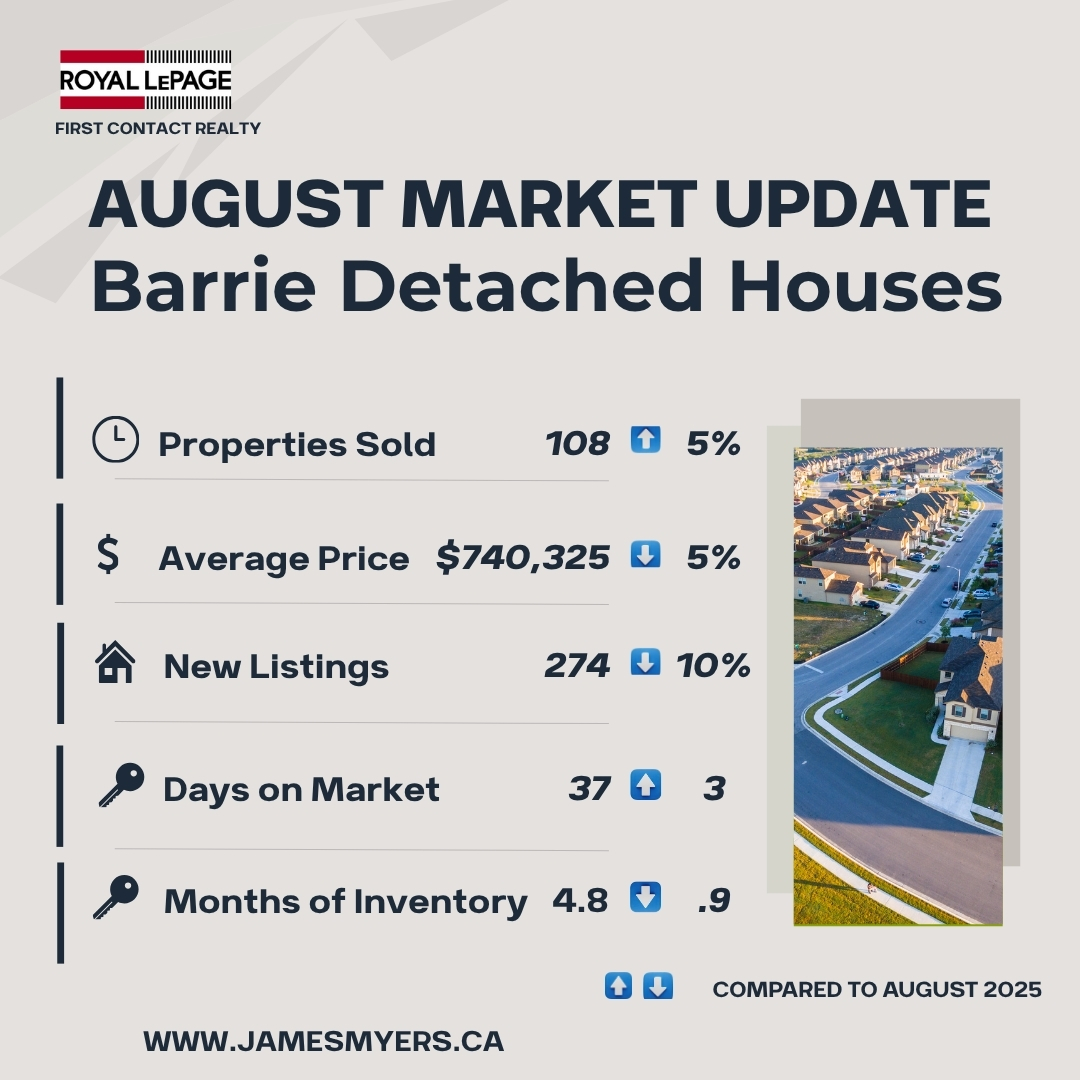
Now let's zoom into Barrie proper, starting with detached houses — because this is actually the strongest segment in the city right now. 108 homes sold, up 5% from last year. Average price came in at $740,325, down 5%. But inline with the numbers we have been seeing throughout 2026. And here's the key number: months of inventory dropped to 4.8, down almost a full month. That's the tightest inventory of any Barrie housing type we're covering today.
Detached homes are the closest thing to a seller's market in Barrie right now — sales are up and inventory is shrinking.
Townhouses in Barrie
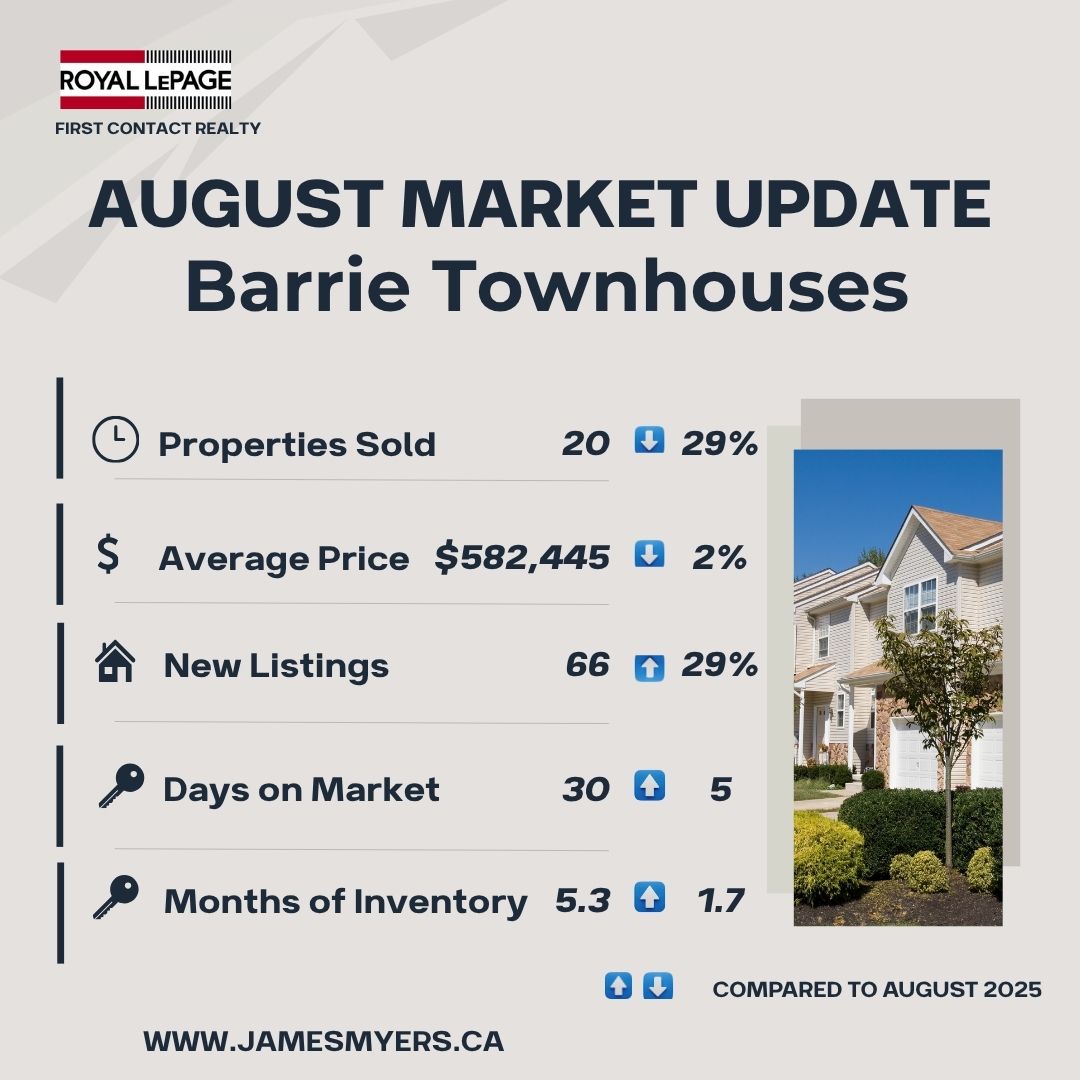
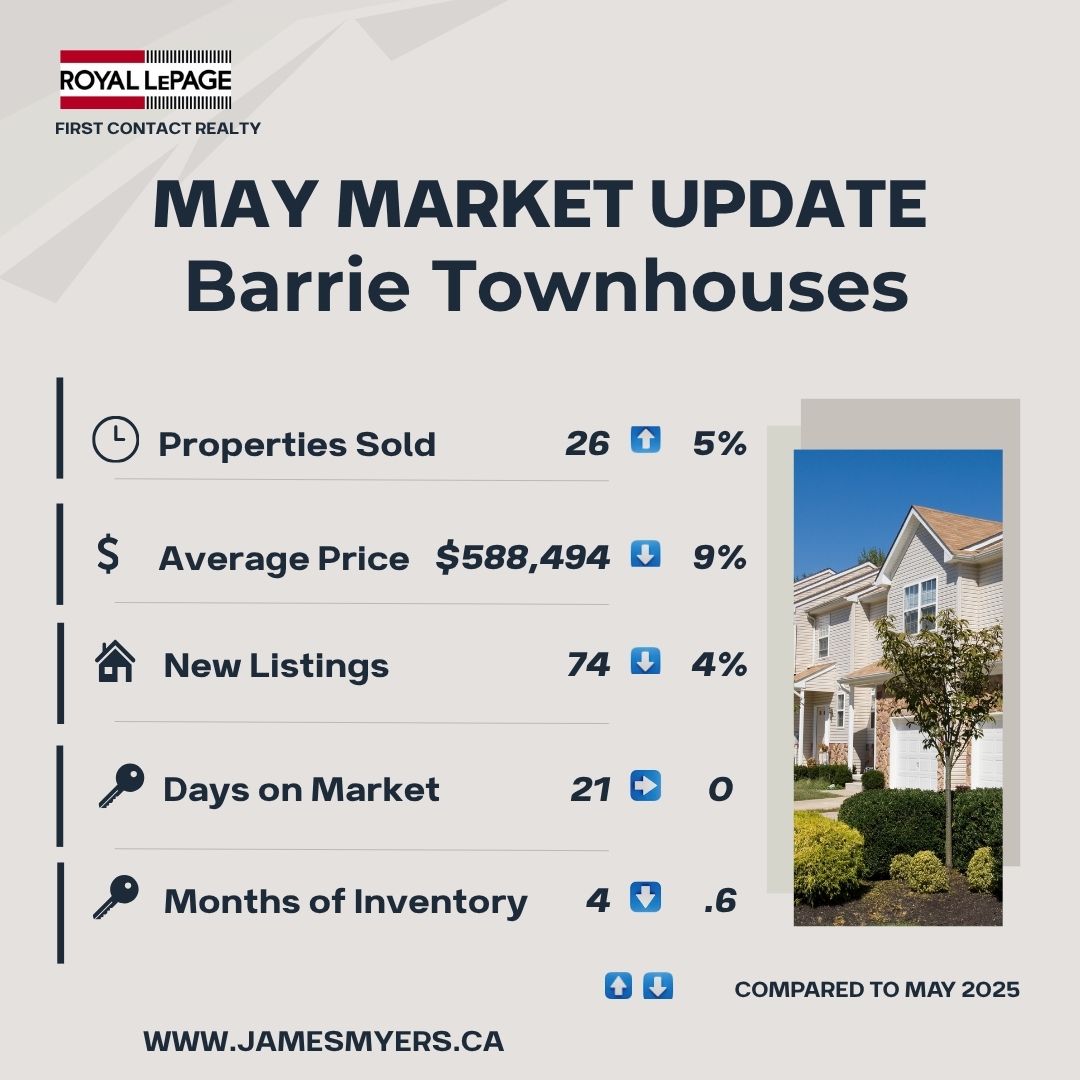
Townhouses tell a different story. Sales were down almost a third to 20 units, while average price dipped 2% to $582,445. What stands out here is new listings — up 29% to 66. More sellers listed, but fewer buyers closed, which pushed months of inventory up to 5.3, an increase of 1.7 months. Days on market also rose to 30, up 5 days.
Townhouses shifted toward buyers in August but I don't think that will last. Townhouses have always been an easy thing to sell in Barrie. Let’s wait and see what the numbers will be in September. I bet they will be back to normal.
Condominiums
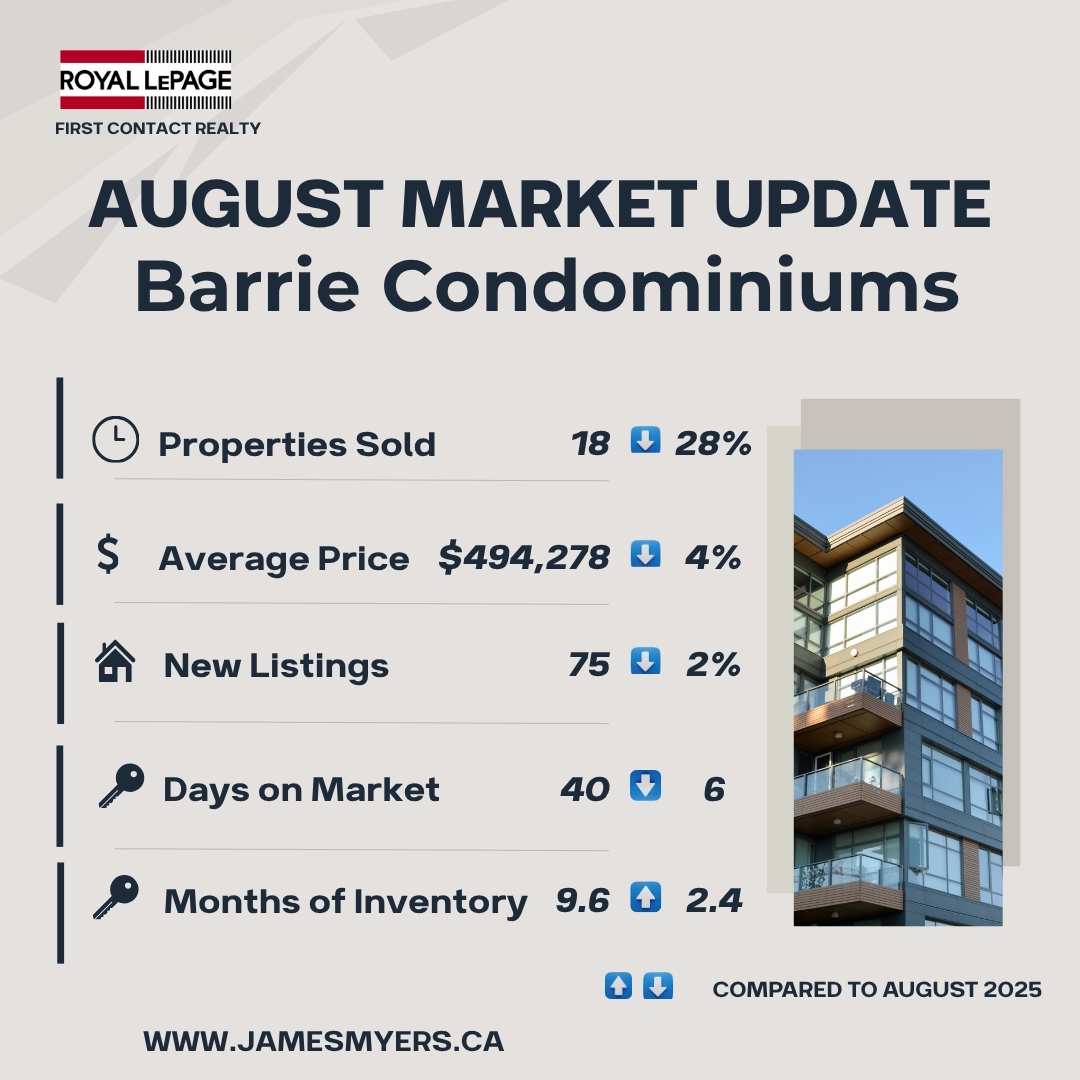
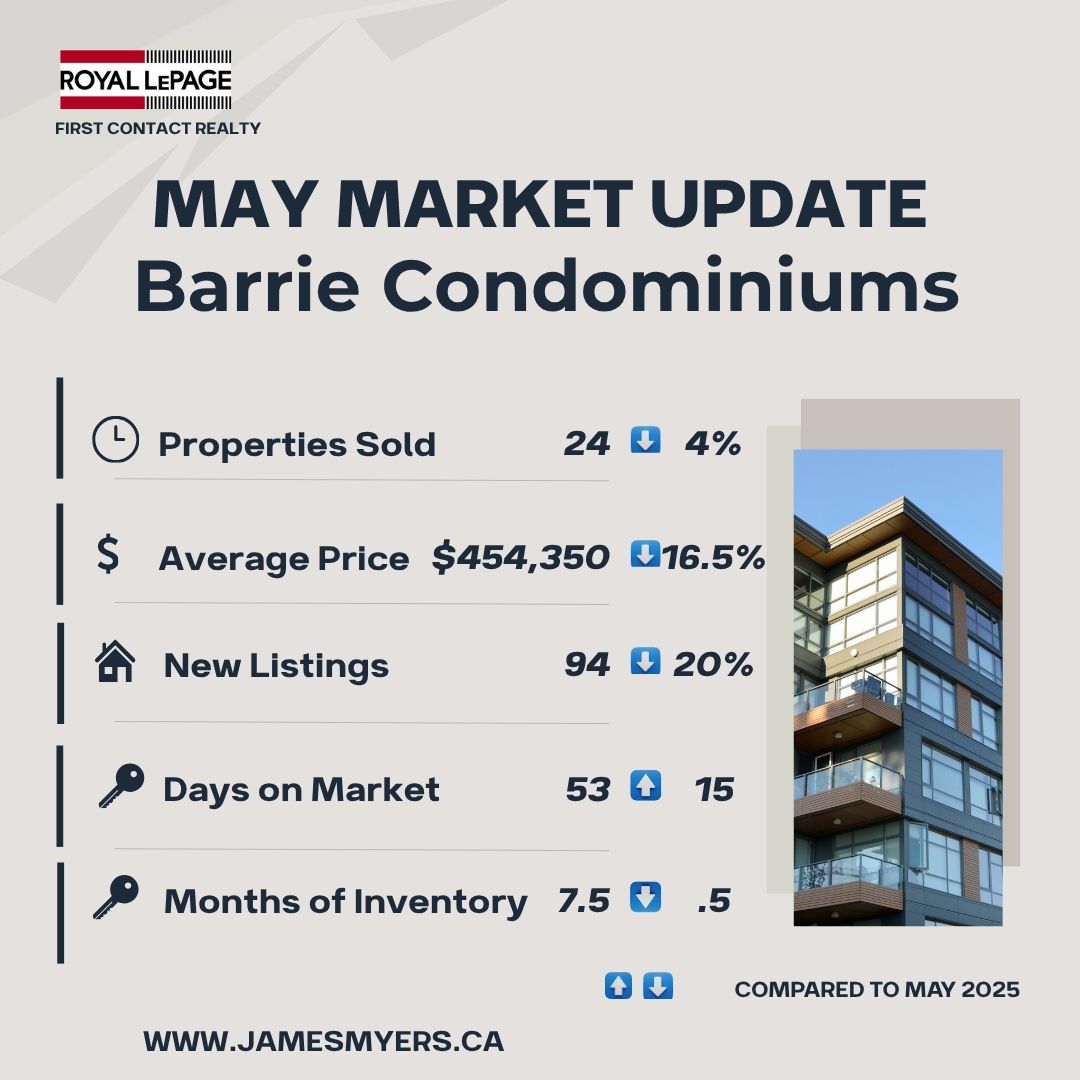
And this brings us around to condos. I thought maybe condos were coming out of their slump last month because both the price and number of sales were up in July but that doesn’t seem to be the case as both of those numbers have fallen back down below last year’s levels. Condos went the opposite way from detached houses in Barrie.
The number that really tells the story is months of inventory: 9.6, up 2.4 months from last year. Interestingly, days on market actually dropped 6 days to 40 — so the condos that ARE selling are moving a bit faster, but overall demand has clearly pulled back."
If you're a condo buyer, you are still in the driver’s seat. If you're selling, pricing and presentation matter more than ever.
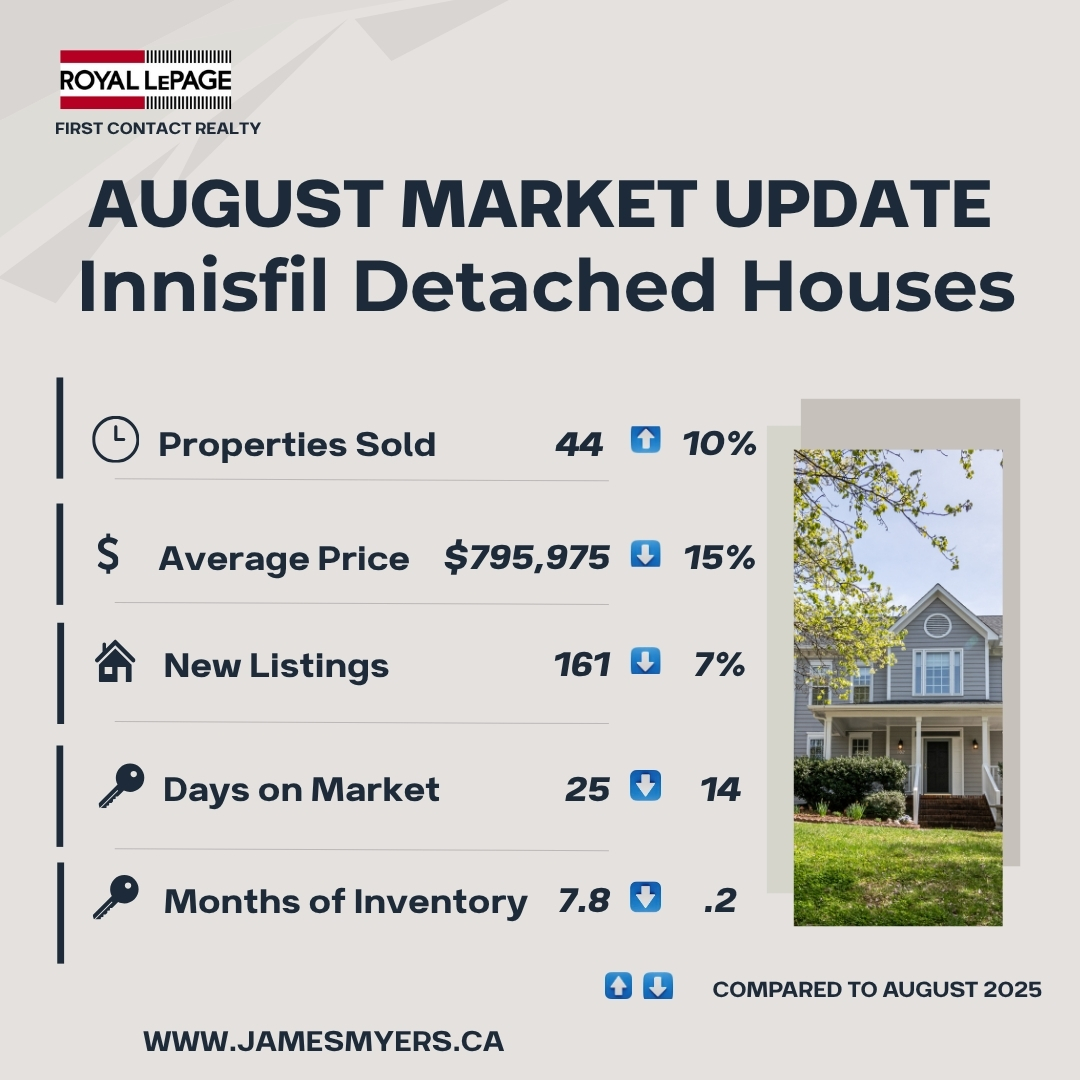
Innisfil Detached
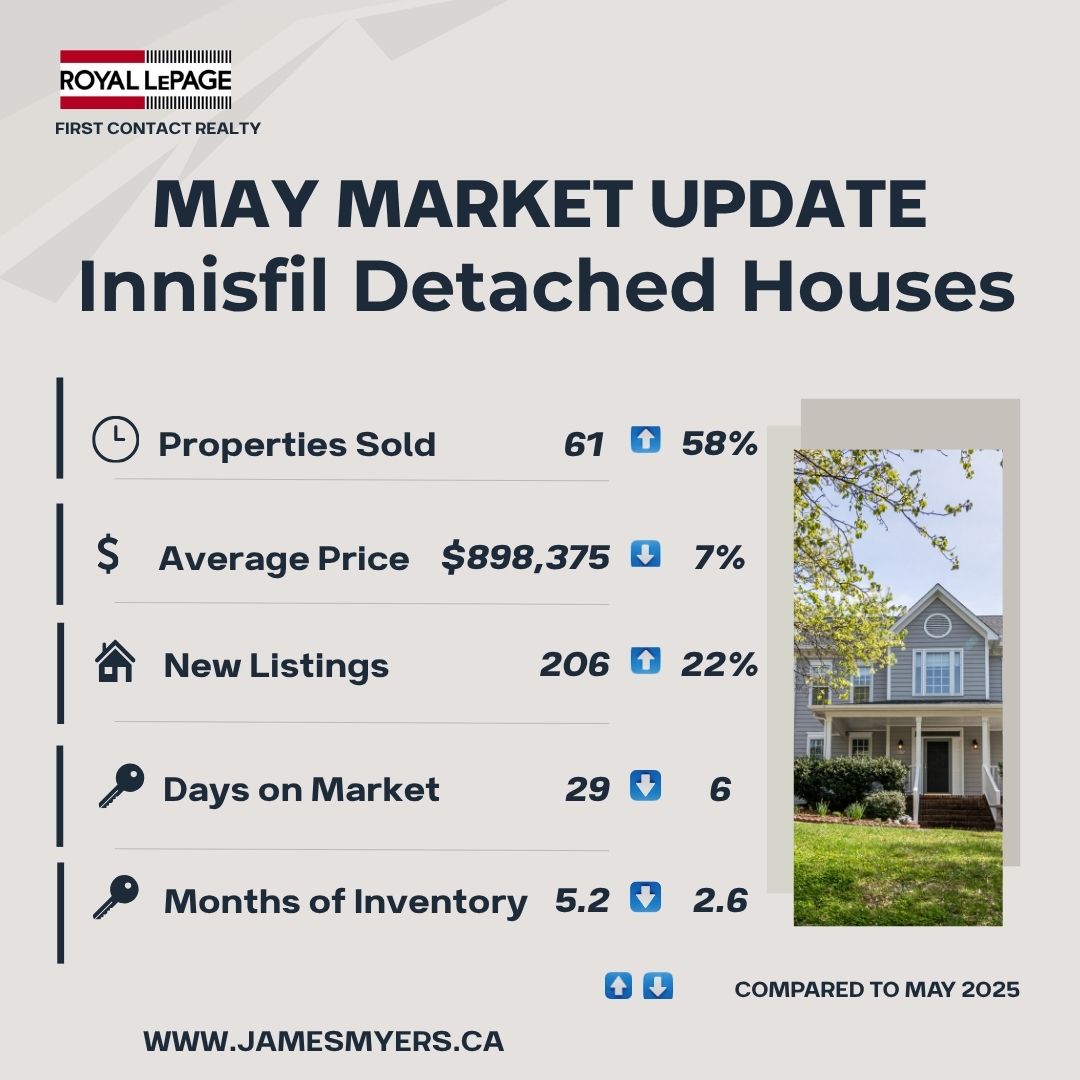
As prices dropped in Innisfil, buyers seemed to come out of the woodwork with sales volume up and DOM dropping 14 days. That means the well priced and well presented houses are selling fast once they come on the market and the houses that are priced for 2022 are lingering. A big 15% drop in price sure helps the buyers too.
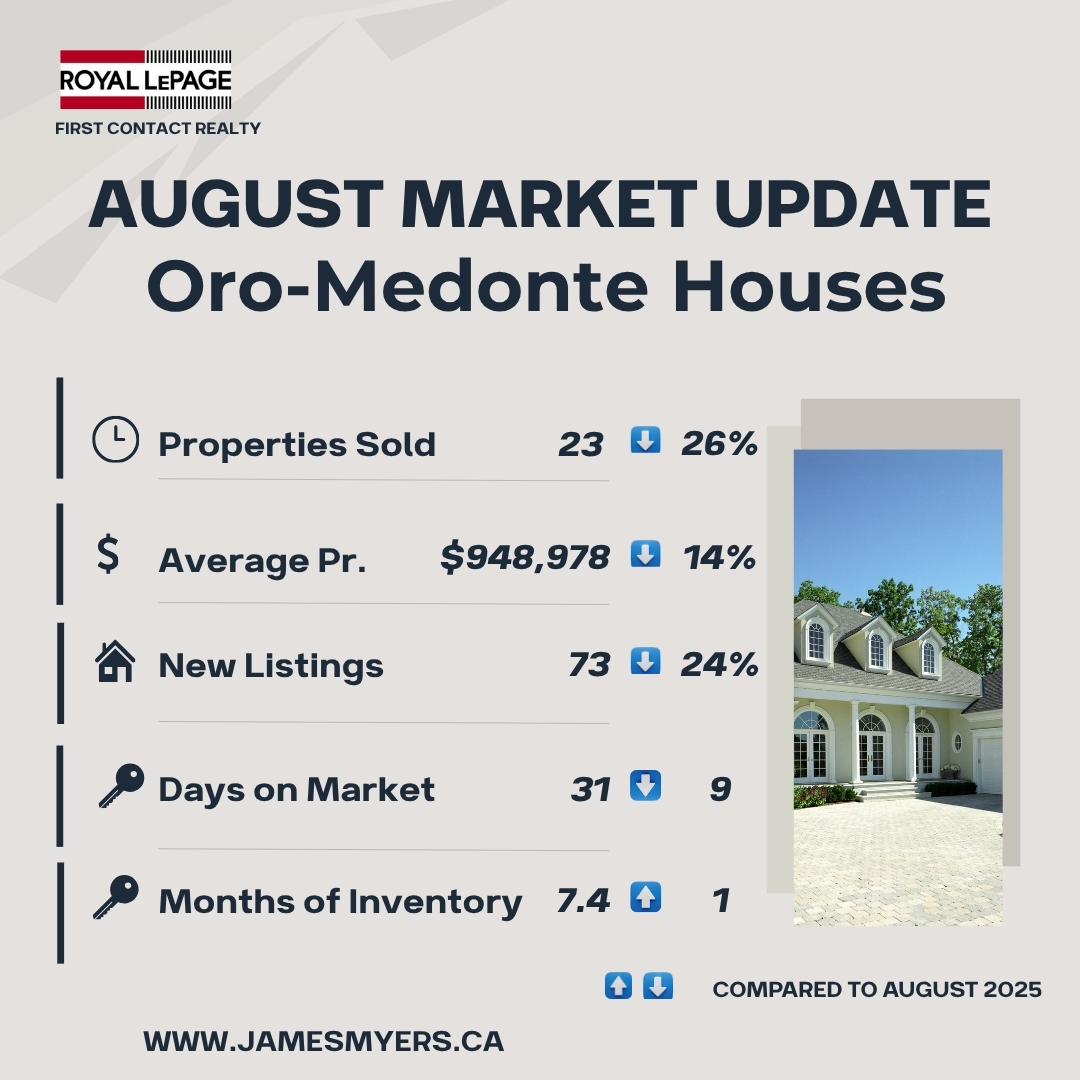
Oro-Medonte
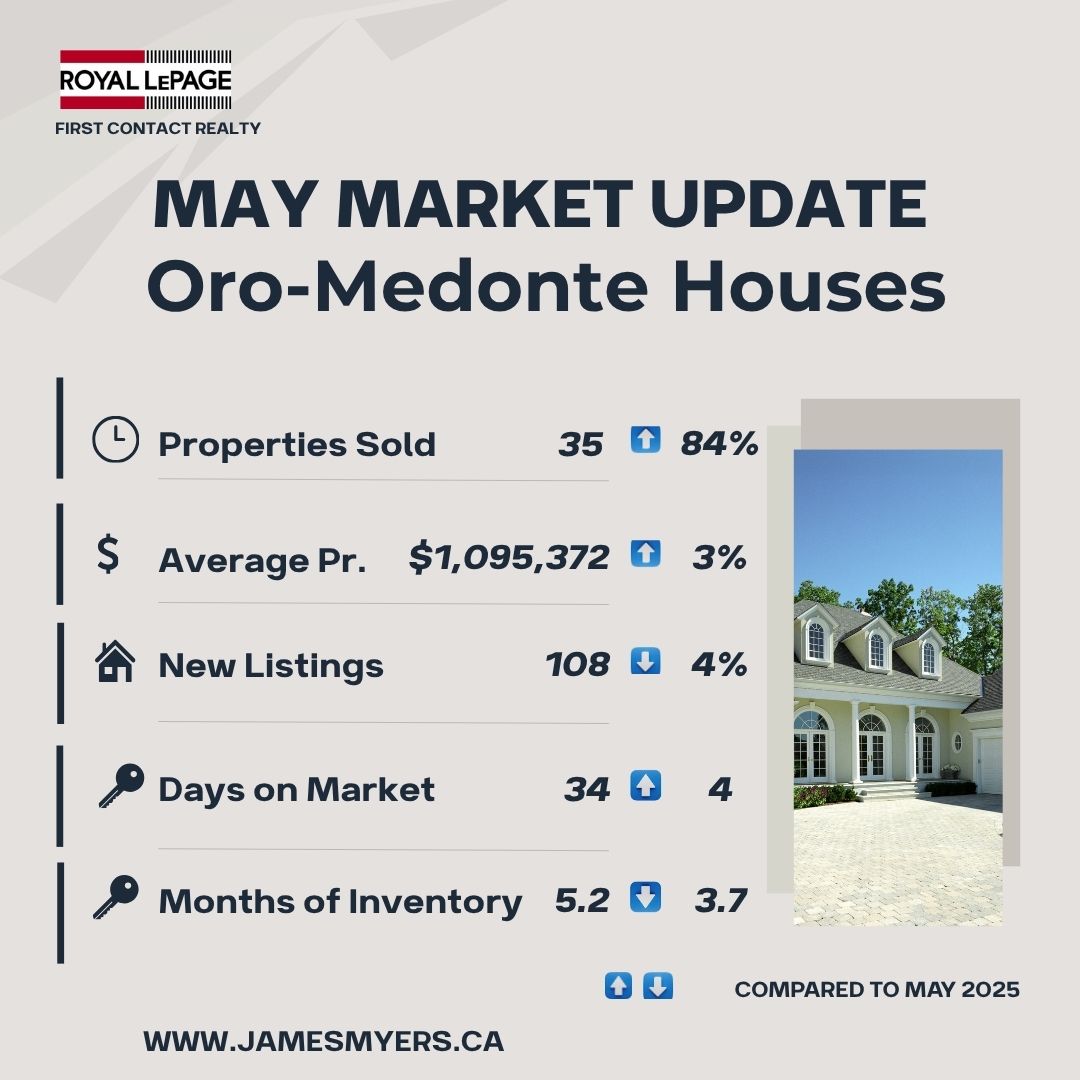
Oro-Medonte took it pretty hard in August. Probably the weakest market in the area today. Prices were down. Sales were down. But DOM dropped by over a week, so again, buyers are out there and good houses sell fast.
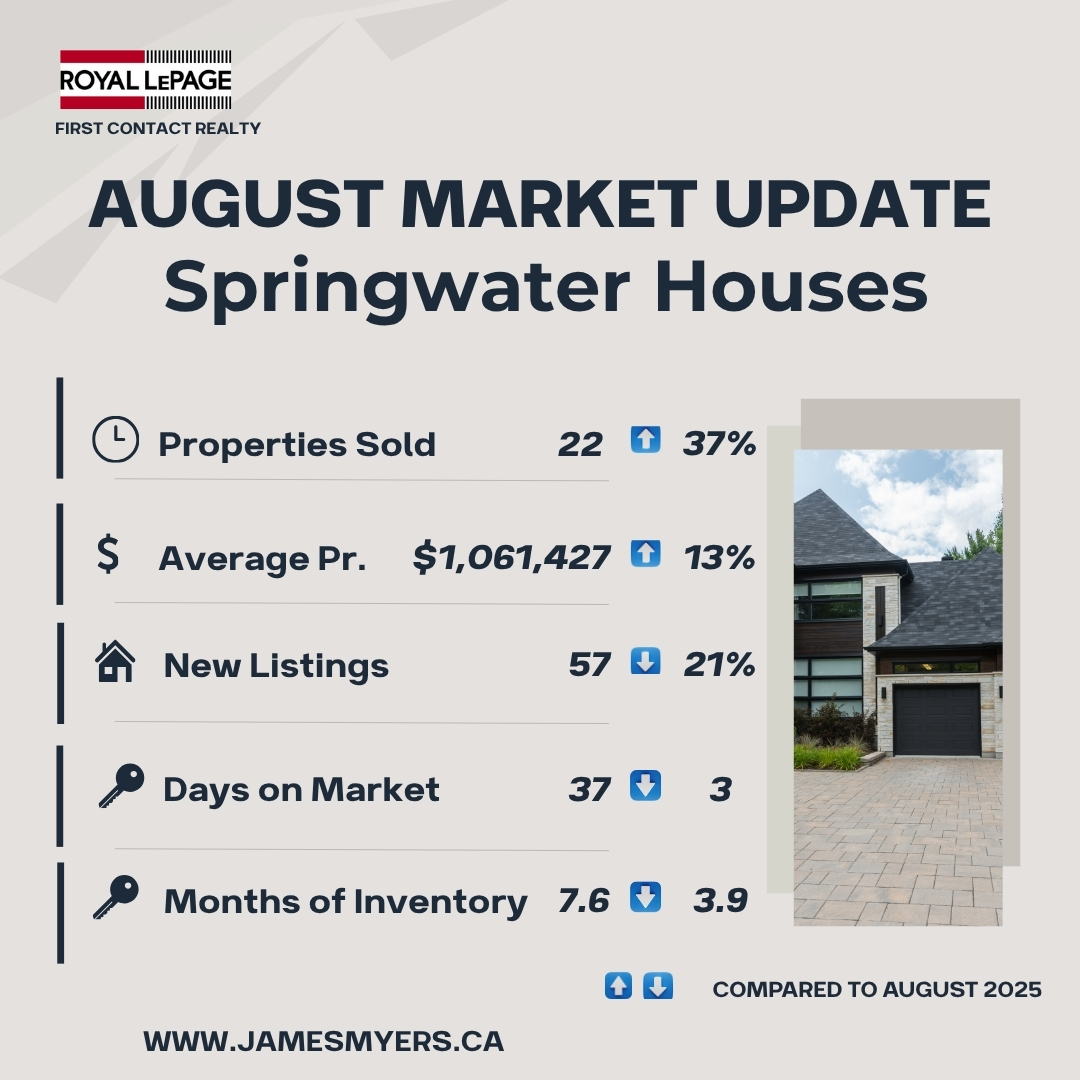
Springwater
Springwater was on fire for sales in August jumping 37% to 22 homes, and average price climbed 13% to over $1,061,000 — now the highest average price of any area we're covering. Higher priced homes generally take longer to sell. The buyer pool is smaller for a $1,200,000 house than it is for a $600,000 house so they do sit on the market longer.
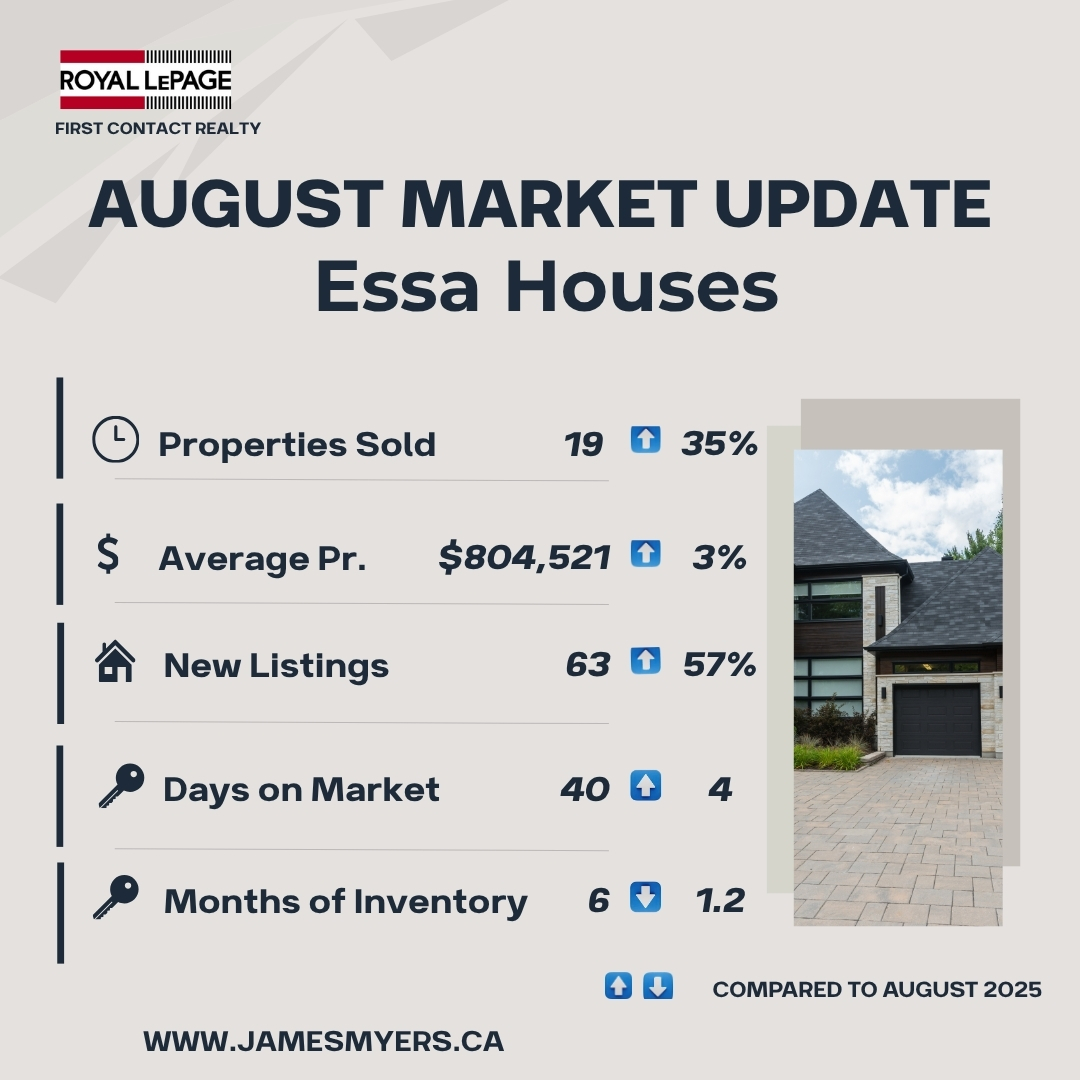
Essa
Essa saw a big boost in both the average price and the number of sales. Well 3% increase in the average price isn’t exactly a huge amount but when you compare it to all the other areas, Essa was the big winner in August. Even with an over 50% increase in new listings, the Months of Inventory still dropped. Essa was the active market in August.
What Does This Mean If You're Thinking of Selling?
And this is probably the most important part for homeowners.
If you're thinking about selling your home this fall, I wouldn't make the decision based on one statistic—or one headline you see in the news.
I'd want to know what's actually happening with homes similar to yours, in your neighbourhood, and how much competition you're going to be facing. Because even in a slower market, properly priced homes are selling.
If you're thinking about selling, or you're considering downsizing and you're wondering what your options look like, feel free to get in touch with me.
I'd be happy to give you an idea of what your home is worth and explain what's happening in your particular part of the market.
But there's a catch. Depending on what you're selling—and where you're selling it—the market can look completely different
The real estate market isn't moving in one direction. It depends very heavily on what you're selling and where you are.
I think the market turn around is just going to happen and most people won’t notice it until it is well underway.
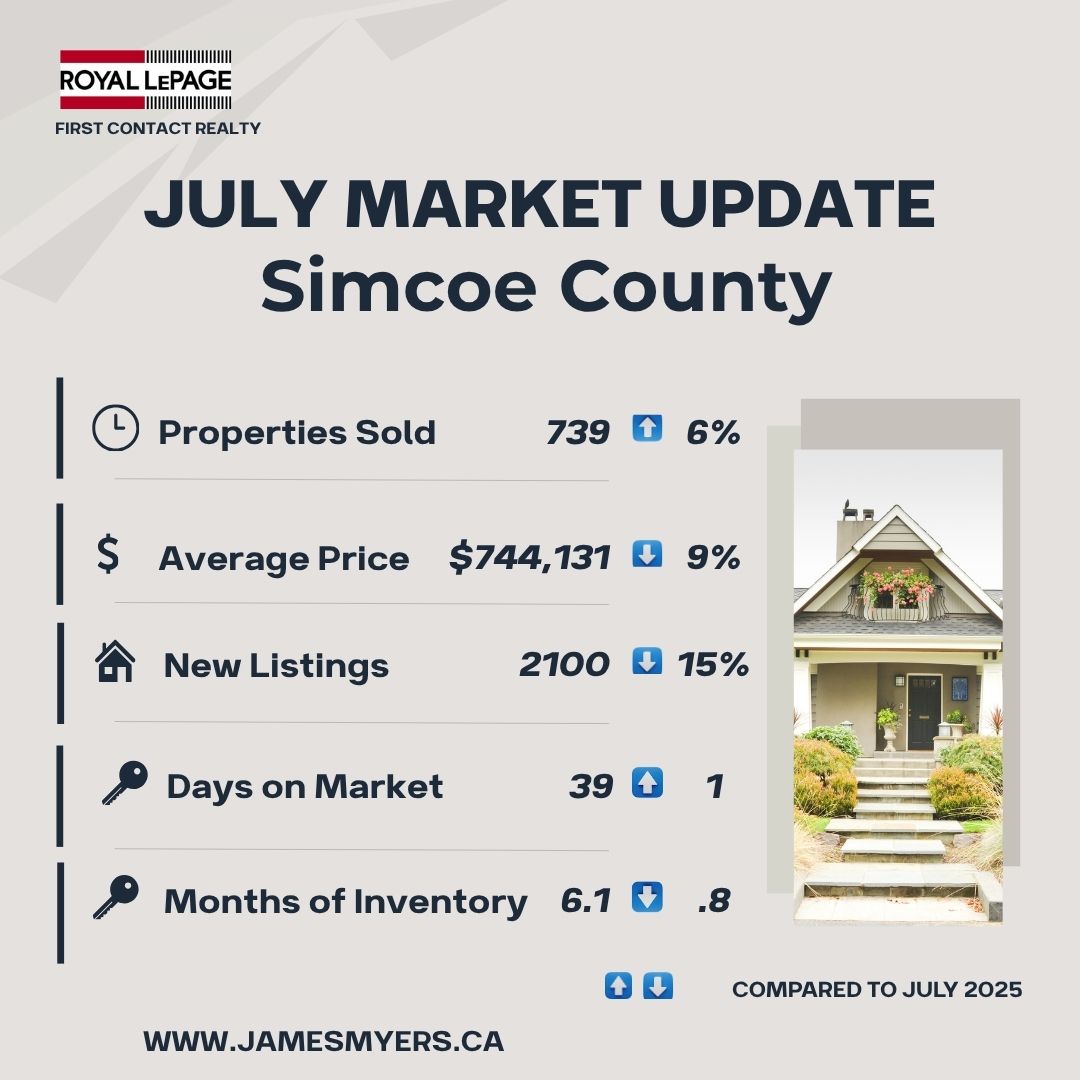
Simcoe County
Here is the big picture for all of Simcoe County.
739 sales, up 6%
Average price $744,131, down 9%
New listings 2,100, down 15%
6.1 months of inventory, down from 6.9
Average 39 days on market
Looking at Simcoe County as a whole, July was actually a little more active than last year, with sales up 6%. Prices are still down 9%, but we're also seeing fewer new listings and inventory has dropped to 6.1 months. So overall, we're still in a buyer-friendly market, but the numbers suggest the market may be starting to tighten up a little.
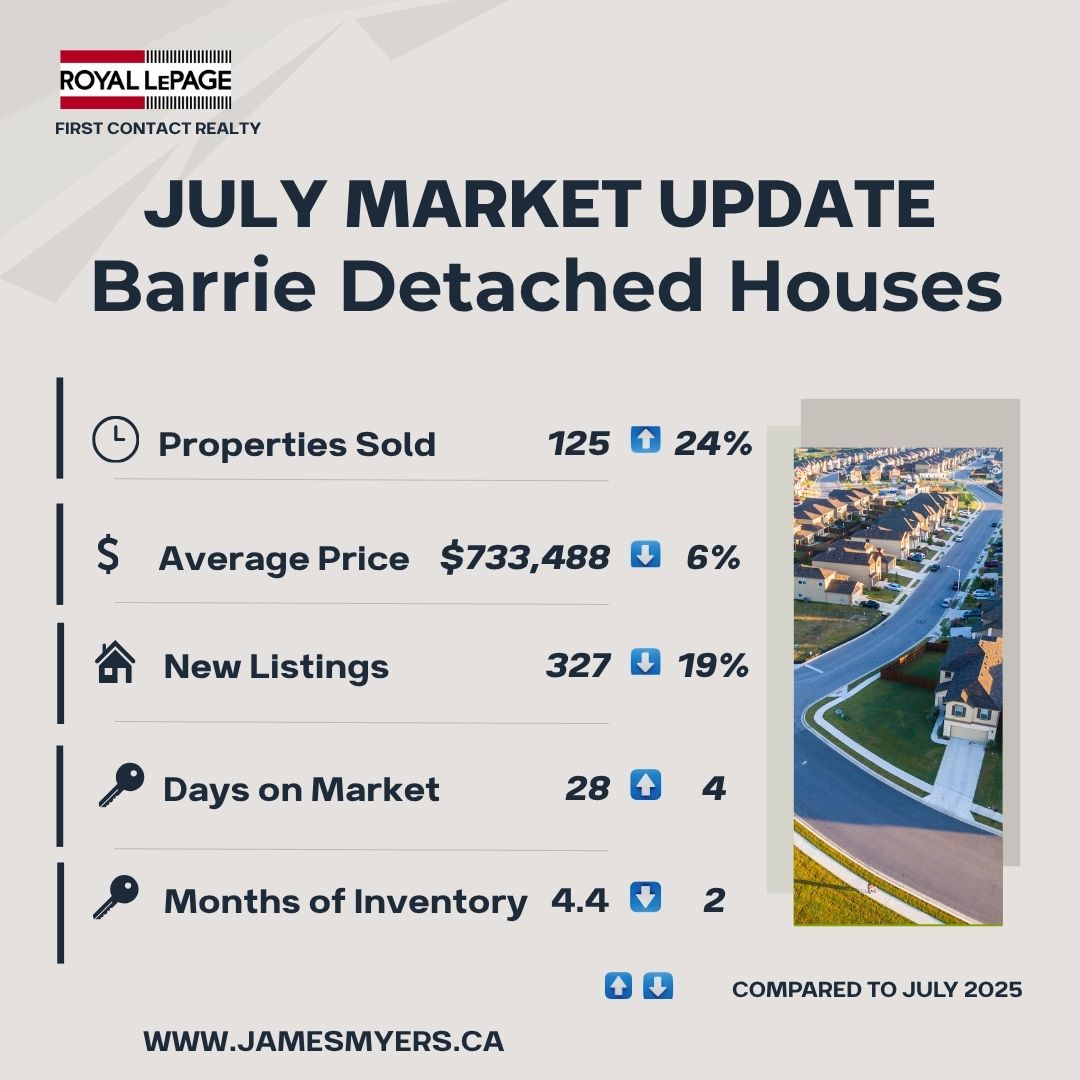
Barrie Detached:
I'm here in Barrie with detached houses because this is one of the encouraging parts of the July statistics."
Sales were up an impressive 24% compared with July of last year.
Now, before I tell you the market is suddenly booming again, there's something else we need to look at.
Prices are still down about 6% from a year ago, so we're certainly not back to the market we had a few years ago."
But look at the inventory. We're down to 4.4 months of inventory."
That is sitting squarely in a balanced market.
So if you're a homeowner with a detached house in Barrie, this is probably the part of the July report I'd be paying the most attention to.
Townhouses:
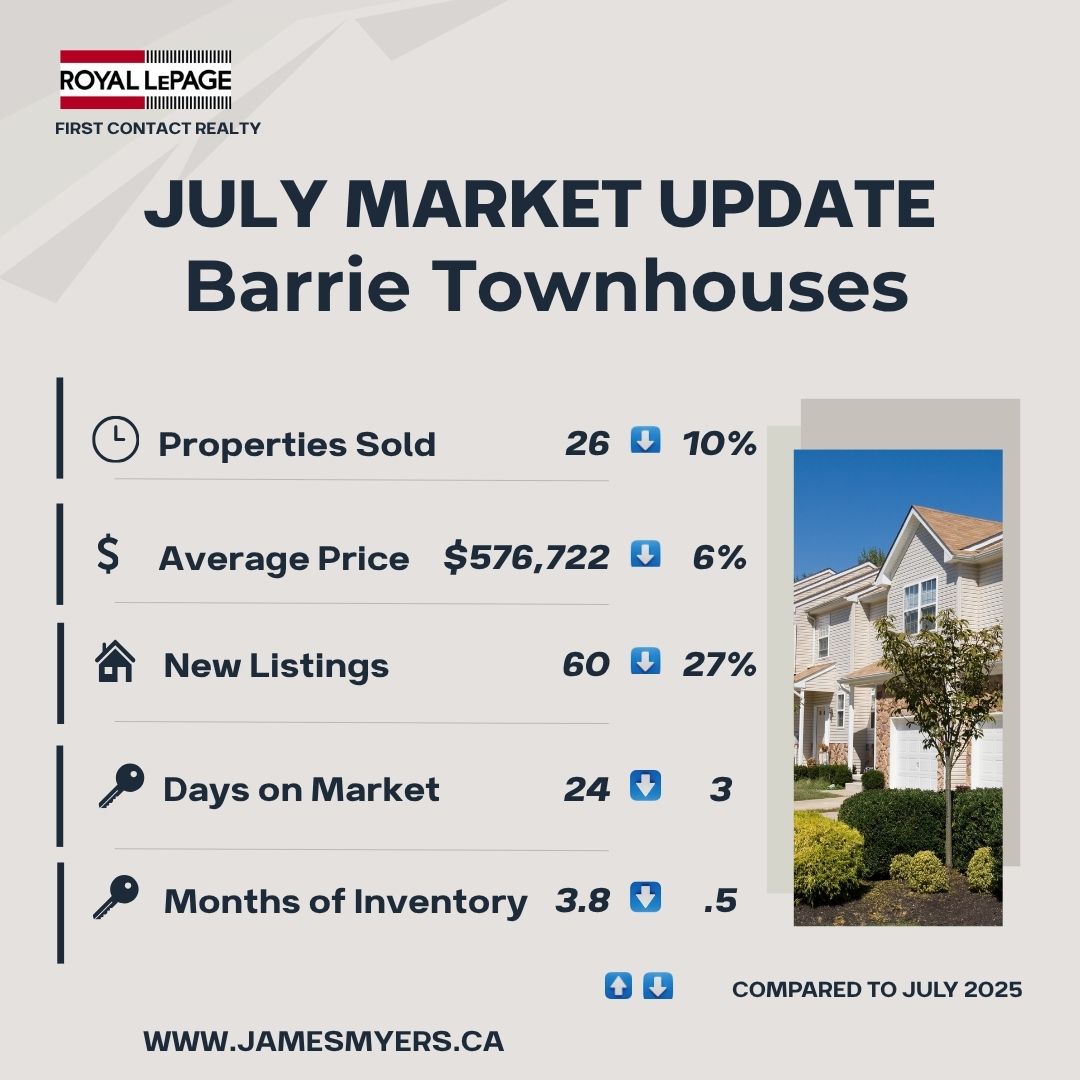
Now let's move down the road a little bit and look at townhouses."
"Something interesting happens here."
Sales are down 10%.
That may sound like a lot but there were only 26 sales in July so that 10% works out to 3 less sales than last year. Not a huge deal in the big scope of things.
So sales are down 10%, but here's the interesting part: new listings are down 27%. There is less inventory for those buyers to choose from. If there had of been more inventory, I bet we would have had more sales. Buyers are still there, they are just waiting for more selection.
Barrie Condos:
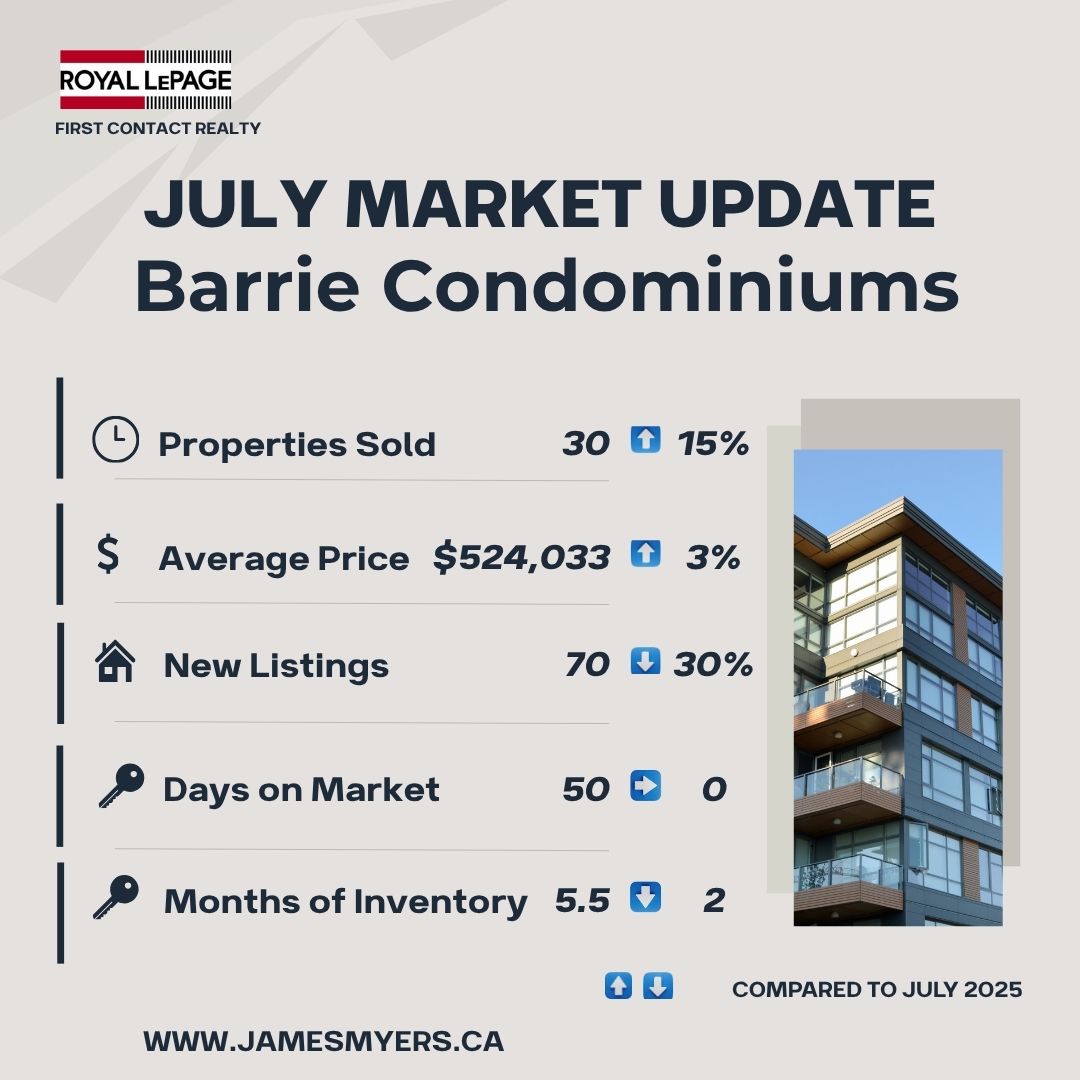
Now we're at one of the more interesting parts of the July report — Barrie condominiums.
And I have to admit, these numbers surprised me a little bit.
Let's start with sales. There were 30 condos sold in July, which is 15% more than we saw in July of last year.
And the average price? $524,033 — up 3%.
So, unlike some of the other segments we're looking at, both sales and prices are actually moving in the right direction.
But there's another number here that I think is even more interesting. There were only 70 new condo listings in July — that's 30% fewer than last year.
And because we have fewer new listings coming onto the market, inventory has dropped to 5.5 months, which is about two months lower than it was a year ago.
Now, 5.5 months of inventory is still not a tight market. Buyers still have choices, and condos are taking an average of 50 days to sell.
But when you put all of these numbers together — more sales, slightly higher prices, fewer new listings and substantially lower inventory — I think there's a reasonable argument that the Barrie condo market may finally be starting to stabilize."
Innisfil:
And this is where things get a little bit confusing. Because if you drive about 20 minutes south of Barrie, the story changes quite a bit.
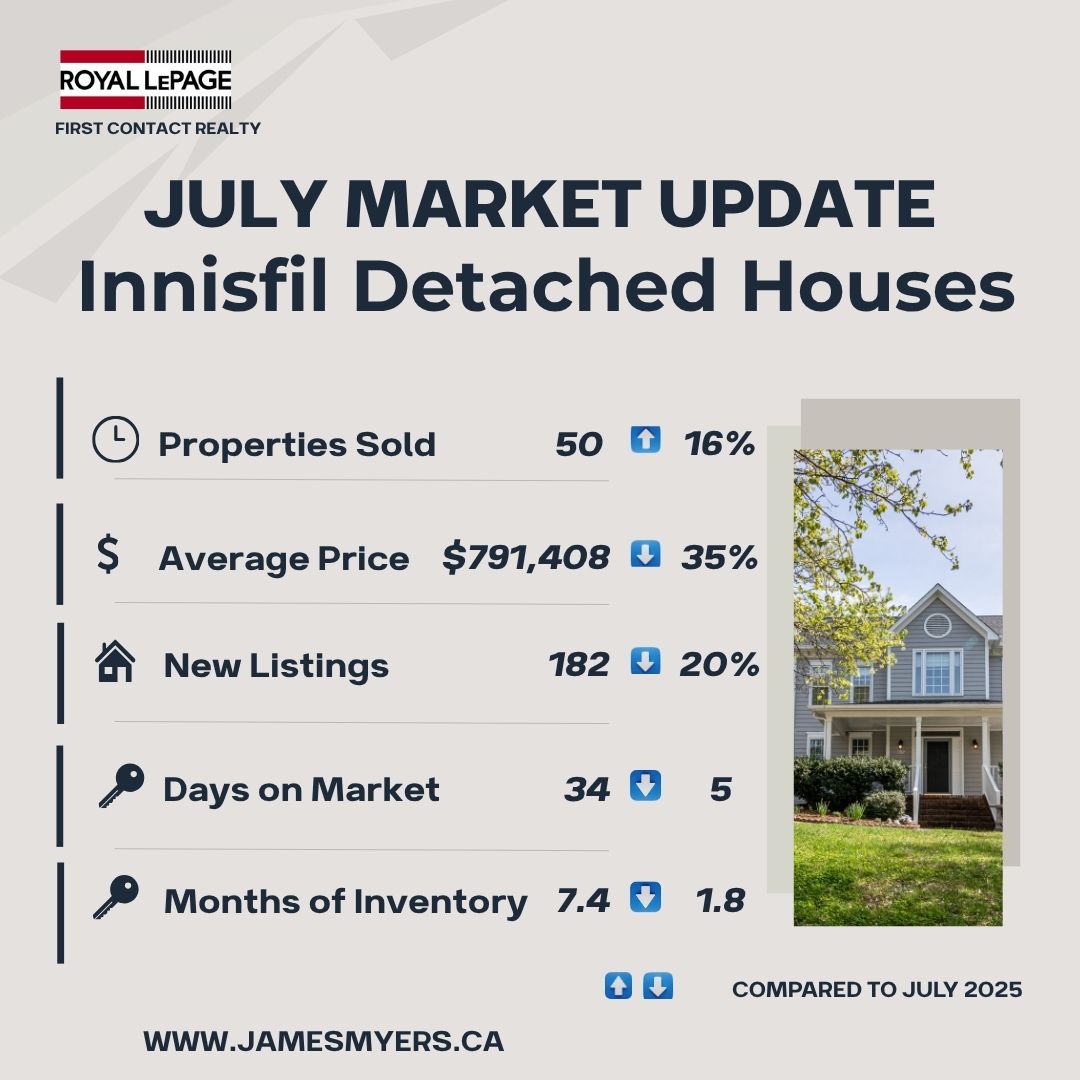
Fifty homes sold in Innisfil during July, which is up 16% from last year. So far, so good.
But the average price was down 35%. Thirty-five percent.
Now, before somebody reading this who owns a house in Innisfil starts preparing to sell at a 35% discount, there's an important caveat here. I went back to my video from last year about July statistics to find out why that number was so high and it turns out there was one sale for $11,500,000 in July 2025 that really skewed the average higher.
So that explains the 35% drop. If you live in Innisfil, don’t panic, your house did not lose 35% of its value in one month.
And now we head north, because the market looks very different in some of the rural areas.
Oro-Medonte
The main story here is that the market has become more challenging for sellers.
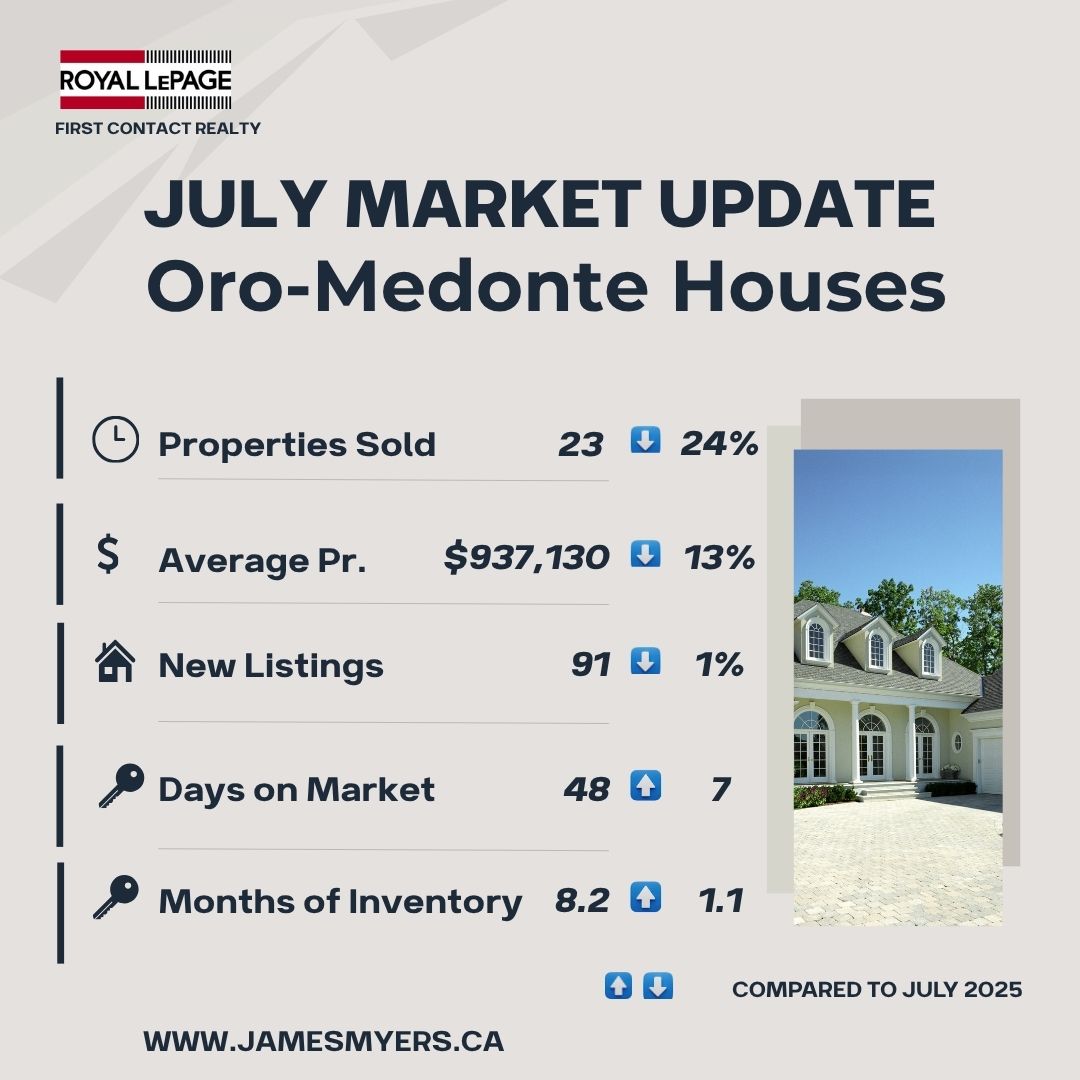
Only 23 properties sold, down 24% from last July. Average price was $937,130, down 13%.
There are now 8.2 months of inventory, up from 7.1. Homes are taking an average of 48 days to sell.
Oro-Medonte continues to be a challenging market for sellers. Sales are down 24%, the average price is down 13%, and we now have over eight months of inventory. So buyers have plenty of choice, and sellers need to be realistic about pricing.
Springwater
Springwater is somewhat similar, but not quite as negative.
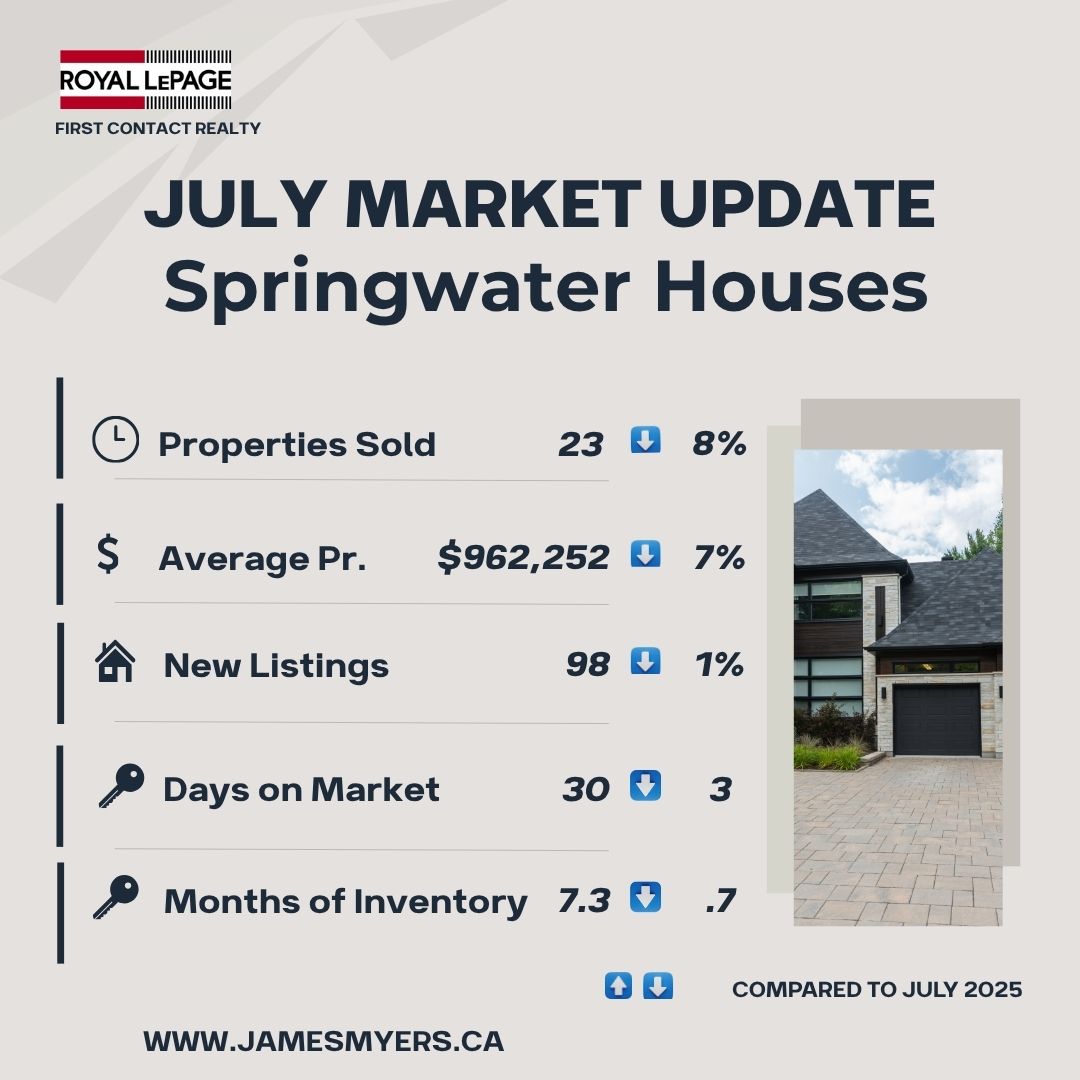
23 properties sold, down 8%. Average price was $962,252, down 7%.
New listings were basically unchanged, down only 1%. Inventory is 7.3 months, down from 8 months.
Homes are taking 30 days to sell.
"Springwater is also a buyer-friendly market, with 7.3 months of inventory. Prices are down 7% from last year, but inventory has actually improved slightly, and homes are selling in about 30 days. So it's a softer market, but it's not necessarily getting worse."
Both Oro-Medonte and Springwater are still buyer-friendly markets, with considerably more months of inventory than we're seeing in Barrie. Oro-Medonte is showing more weakness, while Springwater looks a little more stable.
So, what do I take away from all of this?
Well, I think the biggest thing is that the market is still very different depending on what you're selling and where you are.
In Barrie, detached homes and townhouses are looking considerably healthier in the sales as is Innisfil, and the condo market is showing some encouraging signs as well.
Outside of Barrie, particularly in Oro-Medonte and Springwater, buyers still have quite a bit more choice.
And across Simcoe County, prices are still below where they were a year ago, but we're seeing fewer new listings and less inventory.
So I wouldn't call this a booming market, and we're certainly not back to the market we saw a few years ago. But there are some signs that the market is becoming more balanced.
As always, if you're thinking about buying or selling, the important thing is to look at what's happening in your particular neighbourhood and your particular type of property. The overall Simcoe County number doesn't tell the whole story.
One of the biggest reasons people delay downsizing isn't because they can't sell their house—it's because they don't know where they're going to move. Many people think downsizing means moving into a Condo. The truth is, there are many different options avai;able, and each one has its own pros, cons, costs and lifestyle Today I'm going to walk you through five of the most common choices we see here in Barrie and the surrounding area so you can start thinking about which one might be the best fit for you.
The goal isn’t just to find a smaller place, it’s to find a home that fits the next chapter of your life.
Less home maintenance means more time to travel, visit family or simply enjoy retirement.
Most of these options are designed with accessibility in mind, such as elevators, fewer stairs, wider hallways or step-free entrances.
You may also find that many of your neighbours are in a similar stage of life, which makes it easier to meet people and build new friendships.
My fifth option surprises a lot of people because it's completely different from the others, and it might save you hundreds of thousands of dollars compared to buying another house in Barrie.
One thing to keep in mind about moving from a detached house to any sort of condominium, life lease or 55 plus community is that there are rules to follow. It is a lifestyle change from living in a detached house that you own. You can’t just build a deck, or have 6 cats or paint your front door lime green because you want to. Many things you have to get permission for either from the management company or the condo board or whoever is running the place. And that can be a hard thing for some people to accept.
The housing options that are specifically for people over a certain age usually have an abundance of activities and social events for the residents.
A few things most of these options have in common:
Independent living
Organized social activities
Exterior maintenance handled
Less storage than a regular house. You are downsizing though, right?
1. Waterfront High-Rise Condominiums
There are a few of these in Barrie and they are quite popular. Most of the condo buildings higher than 15 floors or so are within walking distance to the waterfront. From The Bayclub on Dunlop St East which was built in the 1980’s to the recently completed one at 39 Mary St, most of these condos have the typical amenities you would expect in a high rise building. Fitness center, a pool, underground parking. They offer true Lock it and Leave it lifestyle.
These types of buildings are not necessarily all 55 plus residents. Young people, people who just don’t want the upkeep of a house, anyone can live in a condo. So it could not be as quiet as a true 55 plus community.
The monthly condo fees in these types of buildings can be quite high. You have to know what is included in the fees and work that into your overall calculations. For instance I saw a 2 bedroom condo listed for under $400,000 in one of the older buildings on the lakeshore and I thought that seemed like a decent price but when I looked at the fees and what was included it didn’t seem that good anymore. The condo fees were over $1100 per month and the only utility they included was water. No electricity, no heat, no CATV. Lower list price, higher fees. You have to work your numbers.
The views of Kempenfelt Bay are hard to beat for many people, waking up to the water every morning is a big part of the appeal.
If you enjoy walking, you can often leave your car parked for days at a time. Restaurants, the Farmer’s Market, trails, and downtown events are all close by.
Some buildings have active social committees with card games, fitness classes and other events, while others are much quieter. Every building has its own personality.
When comparing condo fees, look at the reserve fund status as well. A healthy reserve fund can help reduce the chance of large special assessments in the future.
Some people may not like the thought of living 10 storeys in the air. Which leads me into my second option:
2. Low-Rise Condominium Buildings
This type of condo is becoming increasingly more plentiful. Many buyers seem to prefer these over towers because they feel more residential and less institutional. You may or may not get underground parking with these depending on the age of the building. Newer ones tend to have underground parking. Some of the older ones like Timberwalk and Edgehill Drive which were built in the 1990’s do not have elevators so that may eliminate them from your consideration but all of the newer ones built in the last 20 years or so have elevators. And there are lots of those to choose from. As the push for higher density housing grows, we are seeing more and more condos every year. These are built all over the city, so whatever area you want, you should be able to find some to your liking. Many of them are very close to grocery stores and shopping, some are even walking distance. These types of condos have really evolved over the years and have more of the stuff people want. Insuite laundry for example - so you do not have to go to the common laundry room and share a washer and dryer with your neighbour. Overall the older ones have less amenities but they are also lower in price. If you want the nice stuff you gotta pay for it.
Many of the newer buildings have party rooms, fitness rooms, rooftop terraces and outdoor barbecue areas, even if they don’t have a pool.
Low rise buildings are often easier to navigate than a large high-rise, with shorter hallways and fewer residents.
If being close to your doctor, pharmacy or grocery store is important, there are now condo developments in many different parts of Barrie that have that convenience.
Some buildings are pet friendly, while others have restrictions, so if you have a cat or dog that should be one of the first things you check.
3. Life Lease Communities
Similar to living in a traditional Condominium, monthly fees on a life lease can vary widely. Most of them in Barrie include the bulk of utilities but verify that for each individual place when you are working your numbers.
Financing on a Life Lease unit can be difficult. Because you don’t actually own a piece of real estate with a deed, traditional banks usually won’t lend against them. Although most people who are moving into these types of places generally have the means to be able to pay cash. Usually from the proceeds of selling their bigger house.
Because you don’t actually own a piece of real estate with a Life Lease, there are some very important differences that you need to be aware of. Not all Life leases operate the same so you need to be aware of the rules for each one. You cannot make changes to the interior of your unit without permission from the organization or non-profit that runs the Life Lease.
There are 3 major Life Lease developments in Barrie. Victoria Village which is close to downtown Barrie. This is in the old Royal Victoria Hospital which moved to its new location in 1996. Terraces at Heritage Square is run by the IOOF Seniors Homes and are 2 buildings at 90 and 94 Dean Ave in the southeast area of Barrie. And then we have Tollendale Village on Hurst Drive. It is a series of 3 storey buildings and a few townhouses with attached garages.
They are all very nice places to live but availability of units in each of these developments varies widely. Victoria Village and Heritage Square usually have places listed for sale on the Realtor MLS system but Tollendale Village units are not listed for sale. They have a substantial waiting list. There is no shortage of people wanting to get in there. Which also makes it easy when the time comes that you have to leave Tollendale for whatever reason. There is no waiting for your unit to sell. Because each Life Lease is structured differently, it is important to understand how you receive your money back when you move out or your estate sells the unit.
One of the biggest reasons people choose a Life Lease is the sense of community. Many of the residents have lived there for years and really look out for each other.
Life Leases are generally designed for people who are still living independently, they are not assisted living or nursing care.
If you are considering a Life Lease, make sure you read the Occupancy Agreement carefully. It is different from buying a traditional condominium.
4. One-Storey Condo Townhouses
Interestingly, as popular as these are, they are few and far between in Barrie. There are a couple of complexes on Little Avenue in the Allandale area of town that have some bungalows and that is it.
There are lots of small condo townhouse complexes in Barrie but none of them are exclusively one storey.
If you can get one, it has the benefits of almost living in a detached house. You get a garage, maybe a small private backyard with a patio, a basement for storing stuff (but again, you are supposed to be getting rid of stuff)
For many people this is the closest thing to having a detached house without all of the outside maintenance.
Having your own front door, garage and patio can make the transition from a family home much easier.
Because there are so few of these in Barrie, they tend to sell quickly when they come on the market.
5. Sandy Cove Acres
Sandy Cove Acres is a Modular home park run by the company Parkbridge. It has been around for years and most people in the Barrie and Simcoe County area have heard about it and may know a little bit about it. It is run as a land lease development where you own the building you are living in but not the land. So you could pick up your house and move it if you wanted but that is not realistic. Nobody does that.
Right now in 2026 you can get a decent house in Sandy Cove Acres in Innisfil for $350,000. Now you do have monthly land lease payments there but you have to work out the numbers as to whether it is worth it financially for you to move there. Your land lease fees are going to be around $1000 per month. If you have a paid for house worth $800,000 you could sell it and buy a place in SCA for $350,000 and after fees have around $400,000 in the bank. A lot of people cannot get their head around paying land lease fees every month and I get that. It’s a different concept from your traditional freehold house.
One of the biggest drawing points is that you still have a detached house and yard without paying the price of a detached house in Barrie.
There is a very active social community with clubs, events and recreational activities that many residents really enjoy.
Because this is a Land Lease community, make sure you understand how the monthly fees work, what they cover and how they may change over time.
If your goal is to free up equity from your current home while still living in a detached house, this can be a very attractive option for some people.
Conclusion
As you can see, there really is not a one size fits all solution when it comes to downsizing. What is perfect for one person may be completely wrong for someone else.
The good news is that Barrie and the surrounding area offer more choices than many people realize.
Before you decide to sell your home, it’s a good idea to look at all of your options, understand the true monthly costs, and think about the lifestyle you want five or ten years from now- not just today.
If you would like to explore what is currently available in any of these types of properties, I would be happy to help you compare them so you can make an informed decision.
After several months of uncertainty, the June housing statistics are beginning to paint a clearer picture of where our local real estate market is headed. Sales across Simcoe County increased compared to last year, inventory continues to be absorbed in many communities, and several local markets are moving closer to balanced conditions.
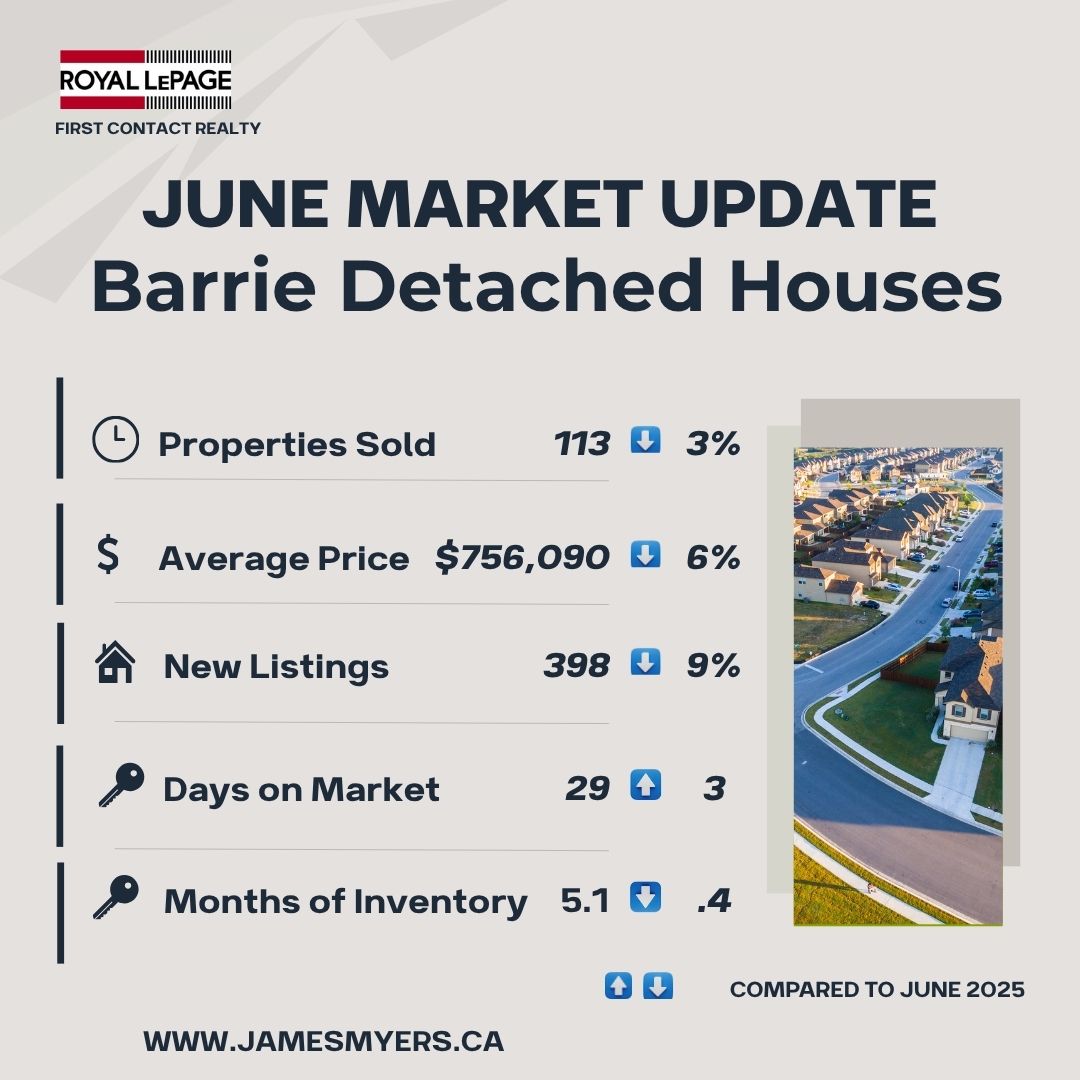
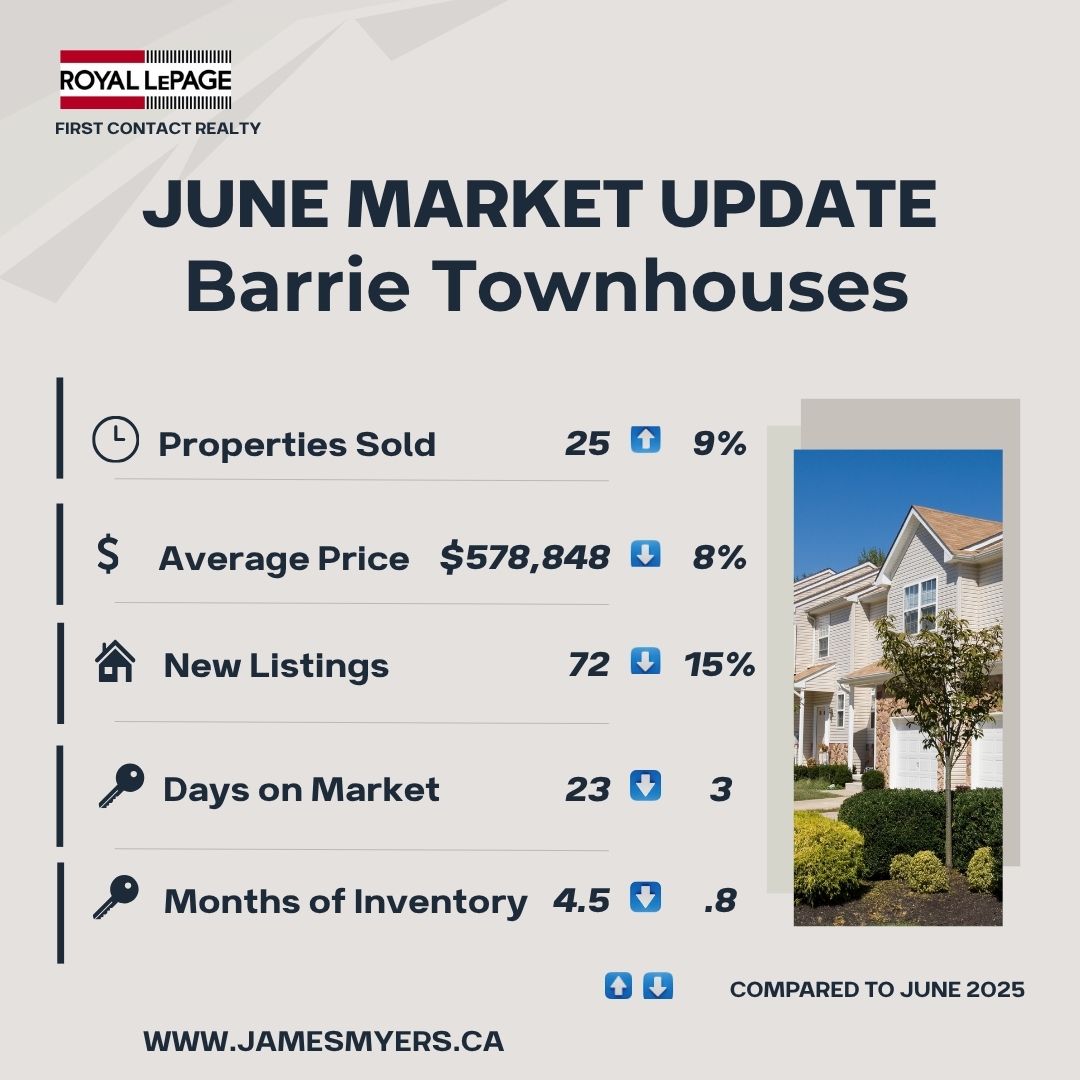
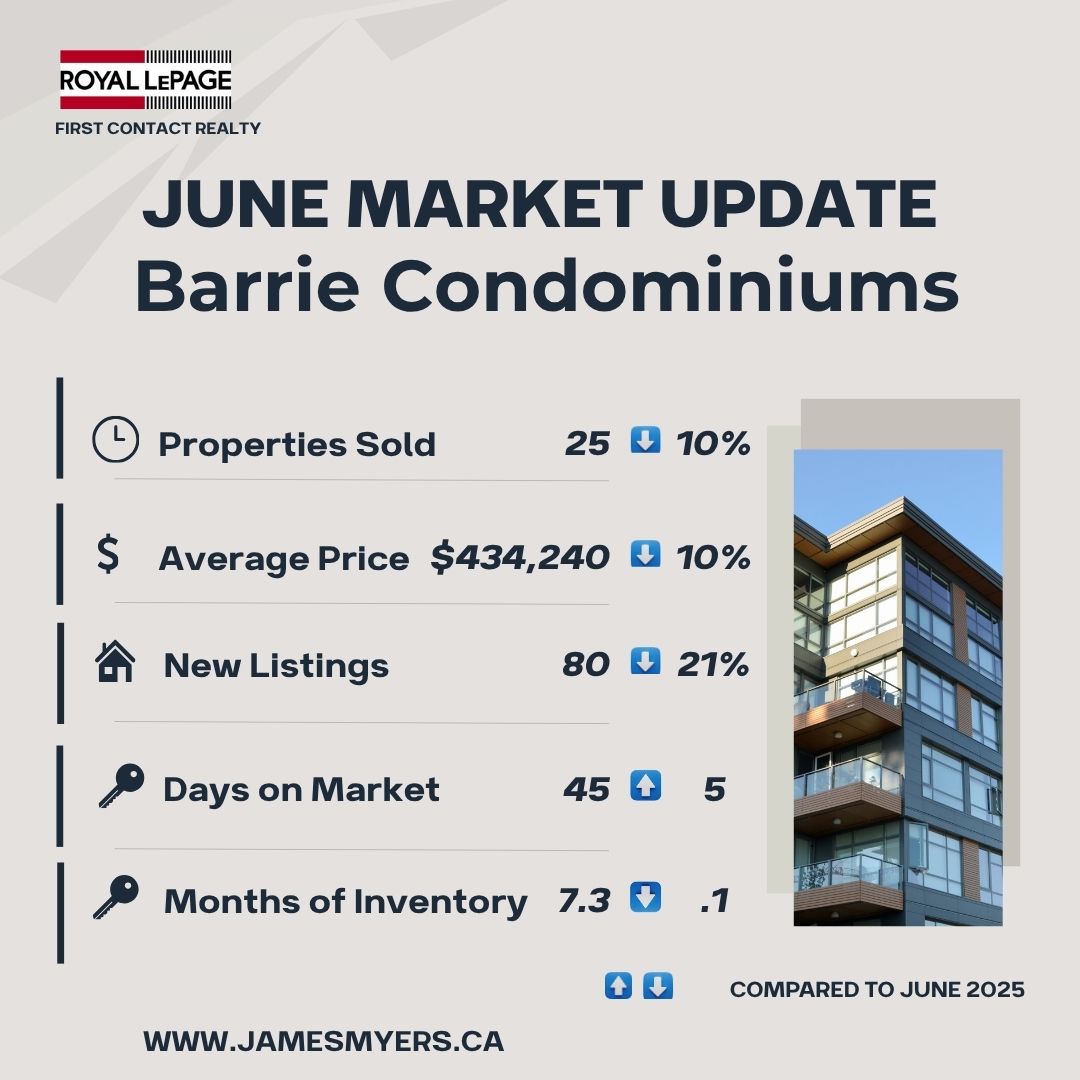
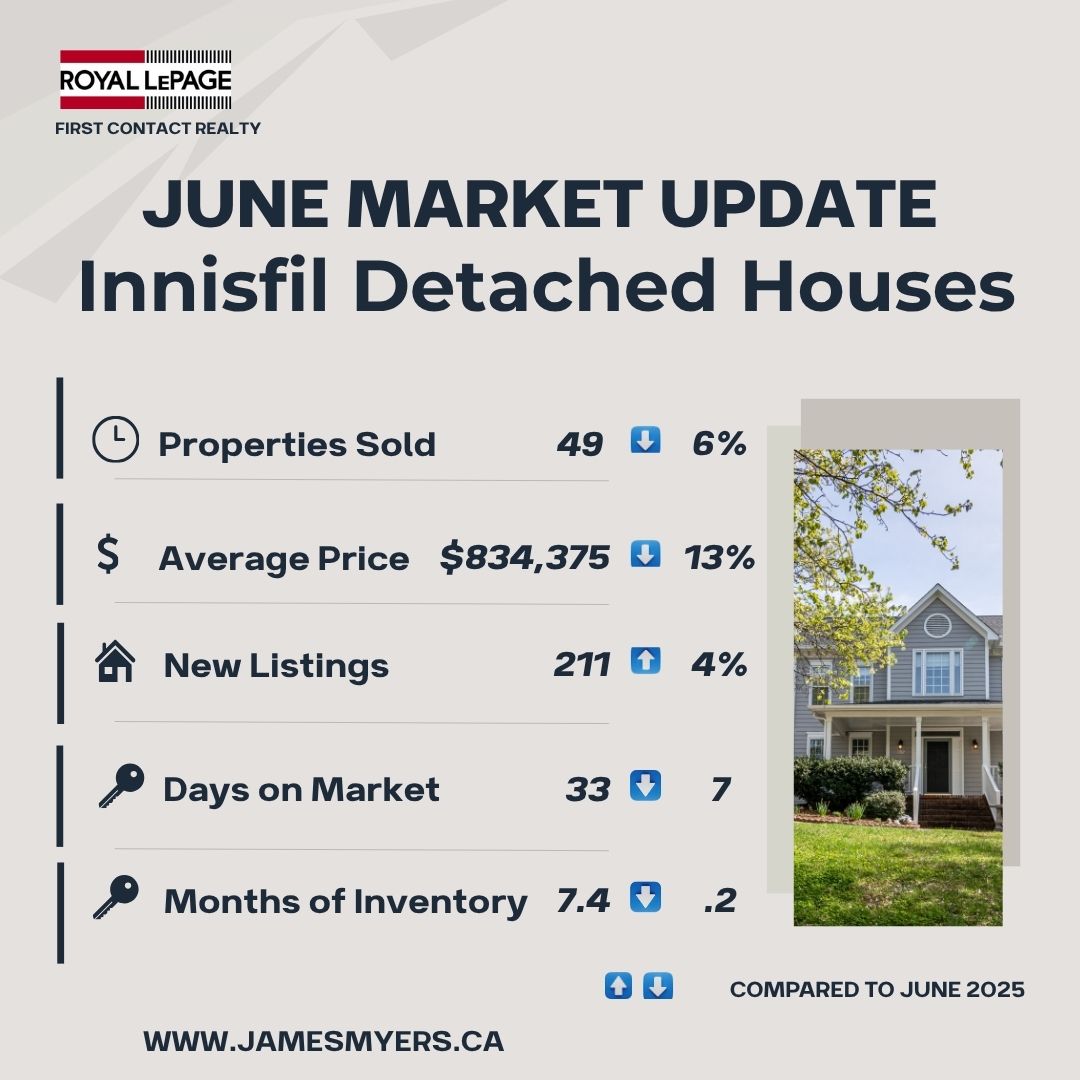
The graphics below compare June 2026 with June 2025 using data from the Toronto Regional Real Estate Board (TRREB). They provide a quick snapshot of home sales, average prices, new listings, days on market, and months of inventory for Barrie, Simcoe County, Innisfil, Oro-Medonte and Springwater. Scroll through the gallery, then continue reading for my analysis of what these numbers mean for buyers and sellers.
While average home prices remain below June 2025 levels, one encouraging trend is that prices have remained relatively consistent throughout the first half of 2026. Rather than continuing to decline month after month, many market segments appear to be stabilizing.
Below is a closer look at the June statistics for Simcoe County, Barrie, Innisfil, Oro-Medonte and Springwater using data from the Toronto Regional Real Estate Board (TRREB).
Simcoe County
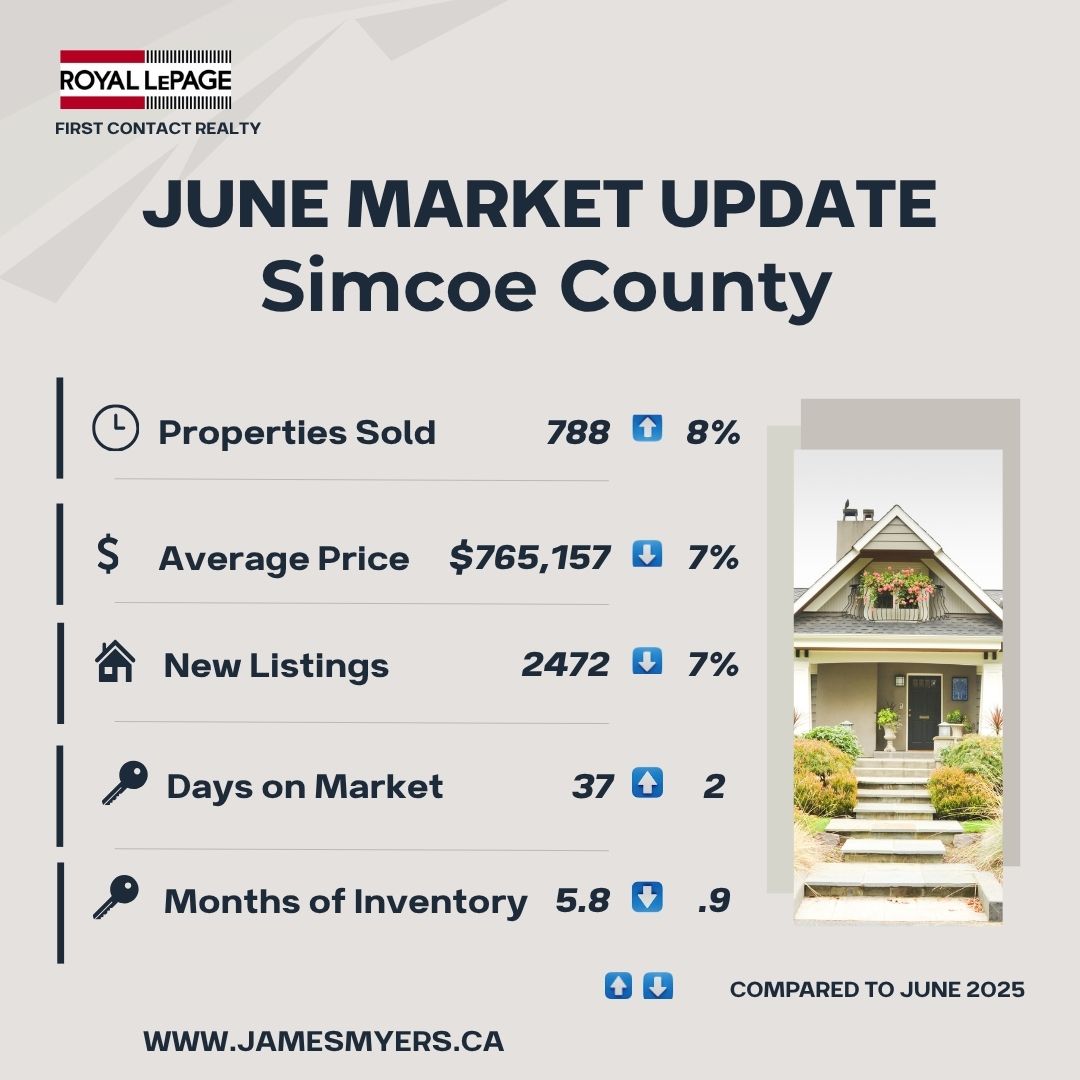
One of the most encouraging statistics this month is the increase in sales. A total of 788 homes sold in June, an 8% increase compared to June 2025, showing that buyers are becoming more active.
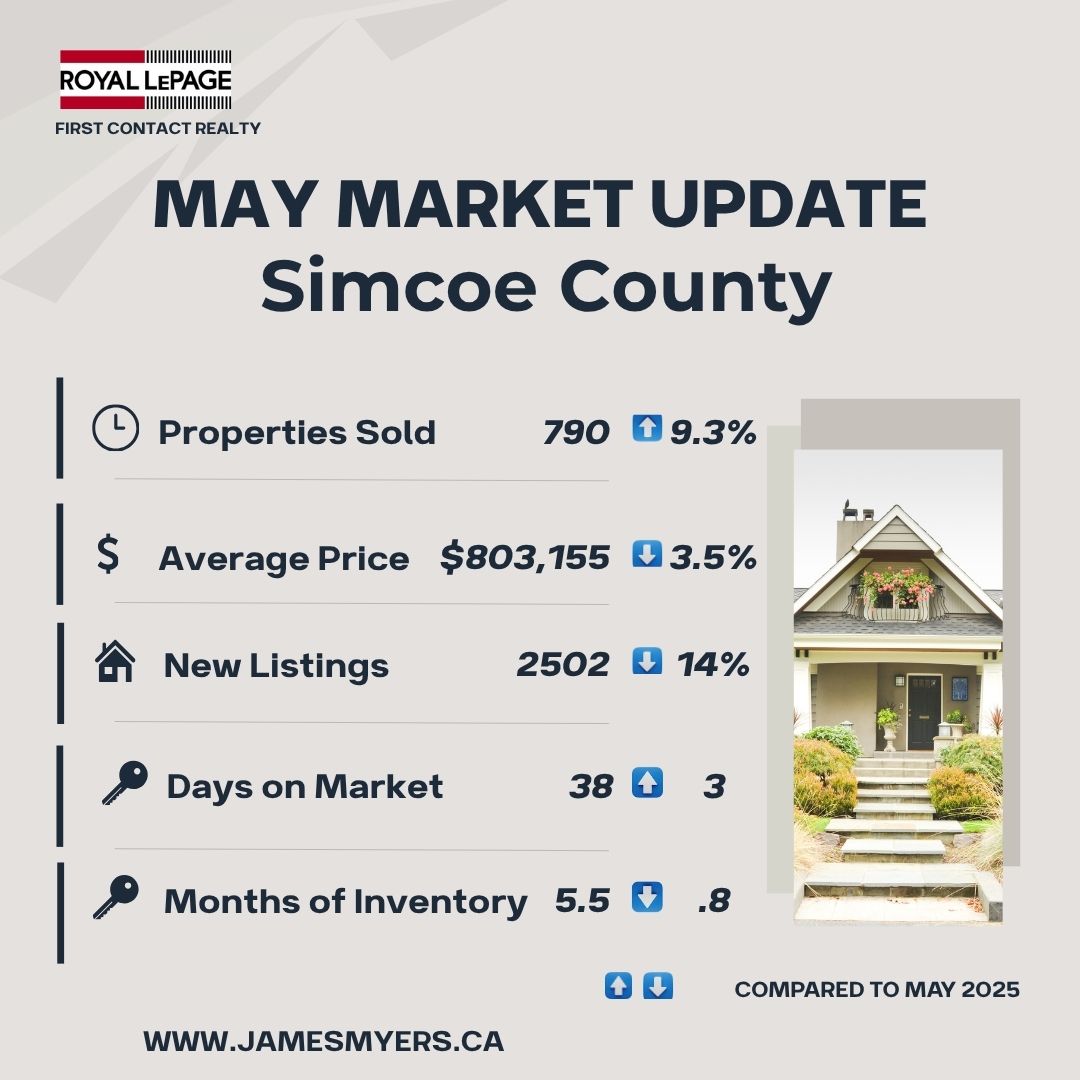
Although the average sale price was approximately 7% lower than last year, it was higher than four of the previous five months in 2026. In May they bumped up to over $800,000 for some reason, but year to date in June, they were at their highest levels in 2026. And that is a trend I see across all segments of the market.
Inventory is down a little compared to 2025, and that puts us under six months of inventory, which is generally considered a balanced market.
Barrie Detached Homes
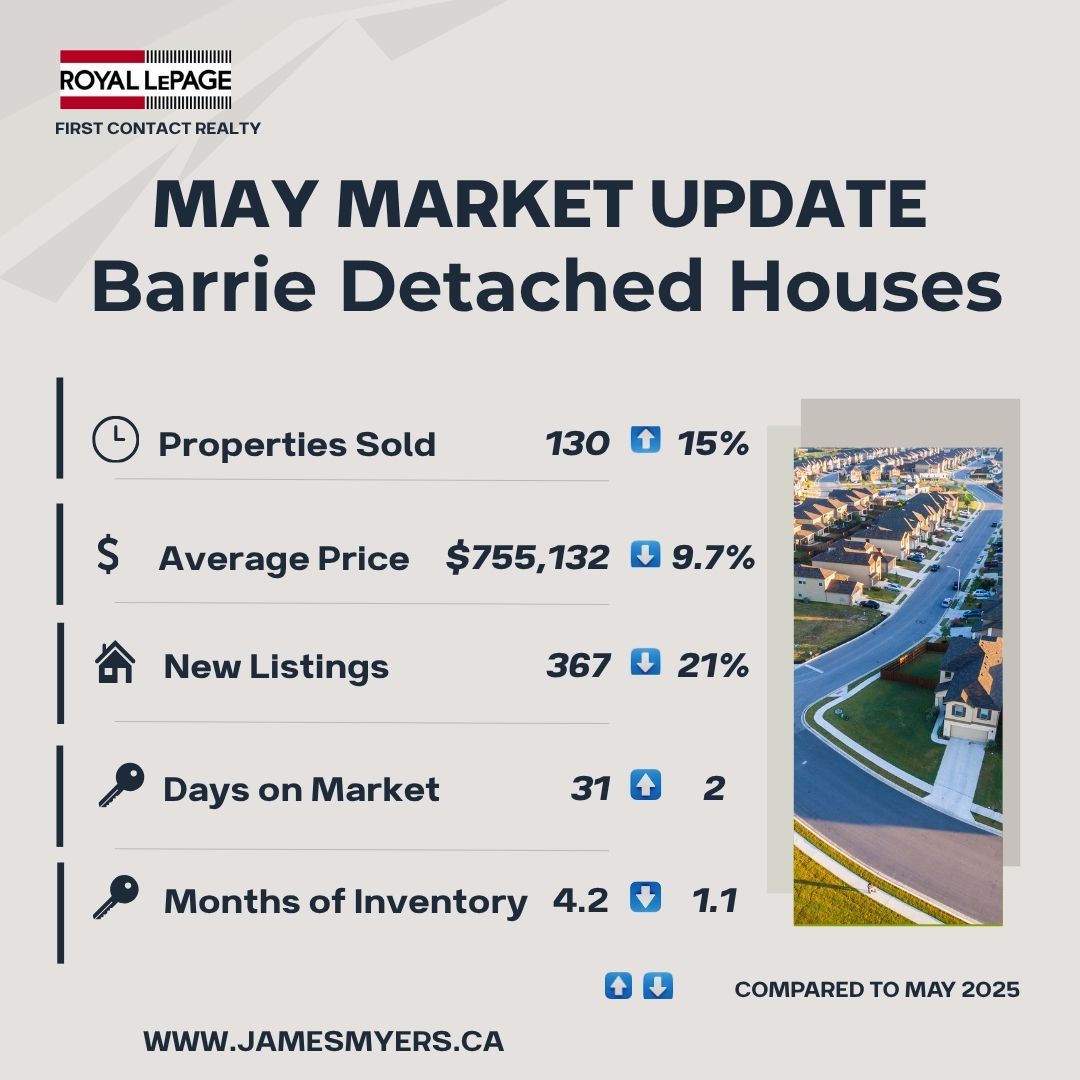
Same as with Simcoe County, June’s average price for a detached house was higher than it was in four of the five previous months and it has been hovering around the $750,000 mark all year.
Barrie's detached home market remained fairly steady in June. Sales were only down 3% compared to last year, despite average prices being 6% lower.
Homes are selling three days slower than last year but about two days faster than they were a month ago.
One statistic I always watch closely is months of inventory. It declined from 5.5 months last year to 5.1 months this June, suggesting the supply of available homes is gradually being absorbed. Well-priced detached homes continue to attract buyers and are generally selling within about a month.
Barrie Townhouses
Townhouses continue to be one of the stablest segments of our local market. Buyers are active, inventory remains reasonable, and prices have been fairly steady over the first half of the year. Although, unlike their detached cousins, Average price for a townhouse was at its lowest level so far this year. Coming in just under $580,000 while the previous 5 months have been over $580,000.
Townhouses had one of the stronger performances this month. Sales increased by 9% compared to last June, even though average prices were down 8%.
New listings also dropped by 15%, which means there was less competition for sellers than there was a year ago.
With inventory sitting at 4.5 months, this continues to be one of the healthiest segments of the Barrie market. Always has been. A good clean freehold townhouse is generally pretty easy to sell.
Barrie Condominiums
Condominiums remain the slowest-moving segment of the Barrie market. Sales and average prices were both down 10% compared to June 2025, and condos are taking longer to sell than other housing types.
Average prices have fluctuated between approximately $425,000 and $475,000 throughout the year. Sales volume has been consistently around 25 since the spring.
Although inventory has improved somewhat, the condo market still has more than seven months of inventory, giving buyers considerable choice and negotiating power.
Innisfil Detached Homes
Innisfil had a softer June than last year. Sales were down 6%, while average prices declined by 13%, making it one of the larger price adjustments in the area. Overall Innisfil has been hovering around the mid $800,000 mark for the bulk of the year.
At the same time, new listings increased by 4%, giving buyers even more options than they had a year ago.
Even with the additional inventory, homes actually sold about a week faster than they did last June, showing that buyers are still out there ready to snatch up well-priced properties.
Oro-Medonte
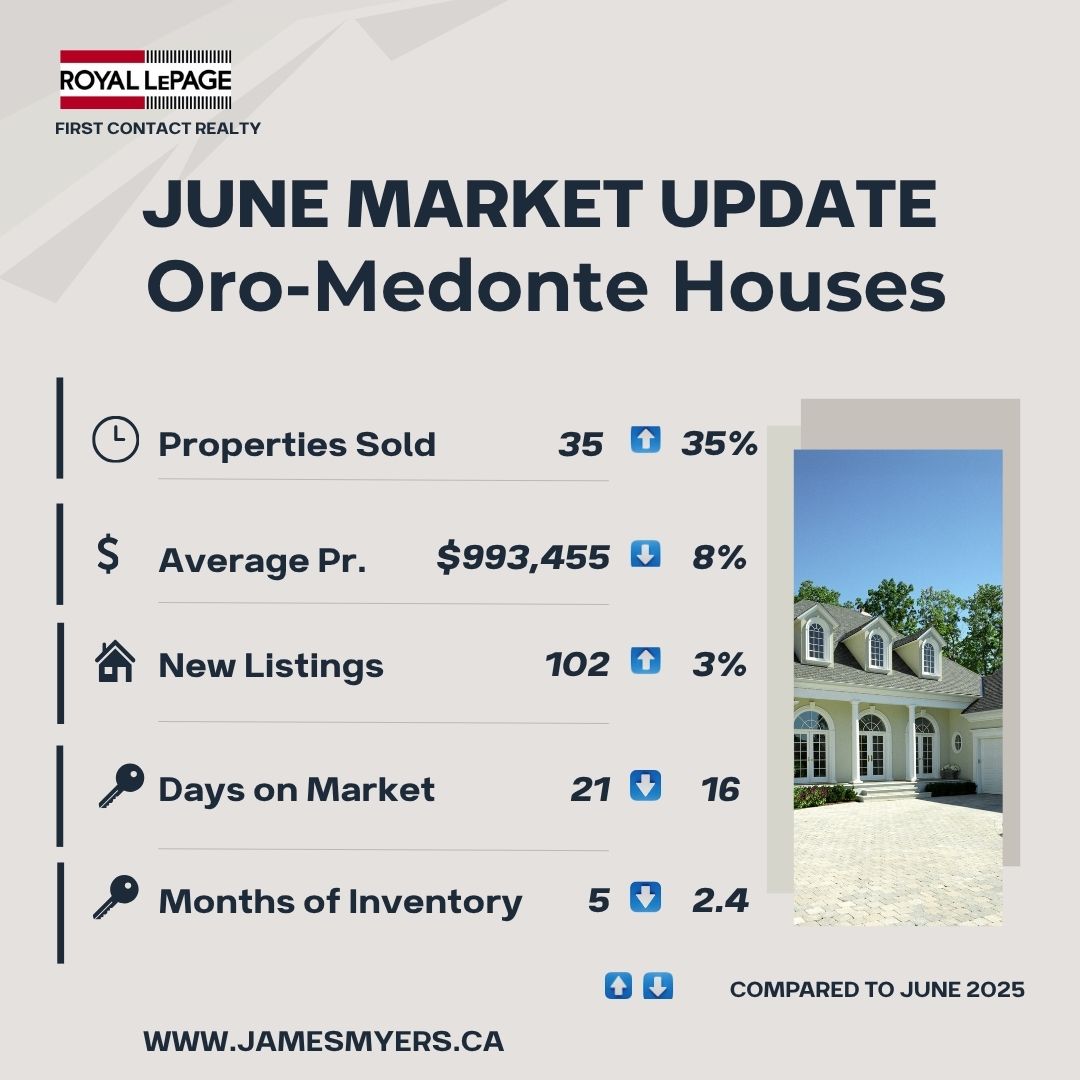
Oro-Medonte had one of the strongest reports this month. Sales jumped an impressive 35% compared to last June, while new listings were slightly higher.
Although average prices were down 8%, homes sold much more quickly than they did a year ago, averaging just 21 days on the market. Average price in Oro-Medonte usually hangs out over a million dollars.
Inventory also dropped slightly, and there were a lot more sales so that drove down the MOI.
Springwater
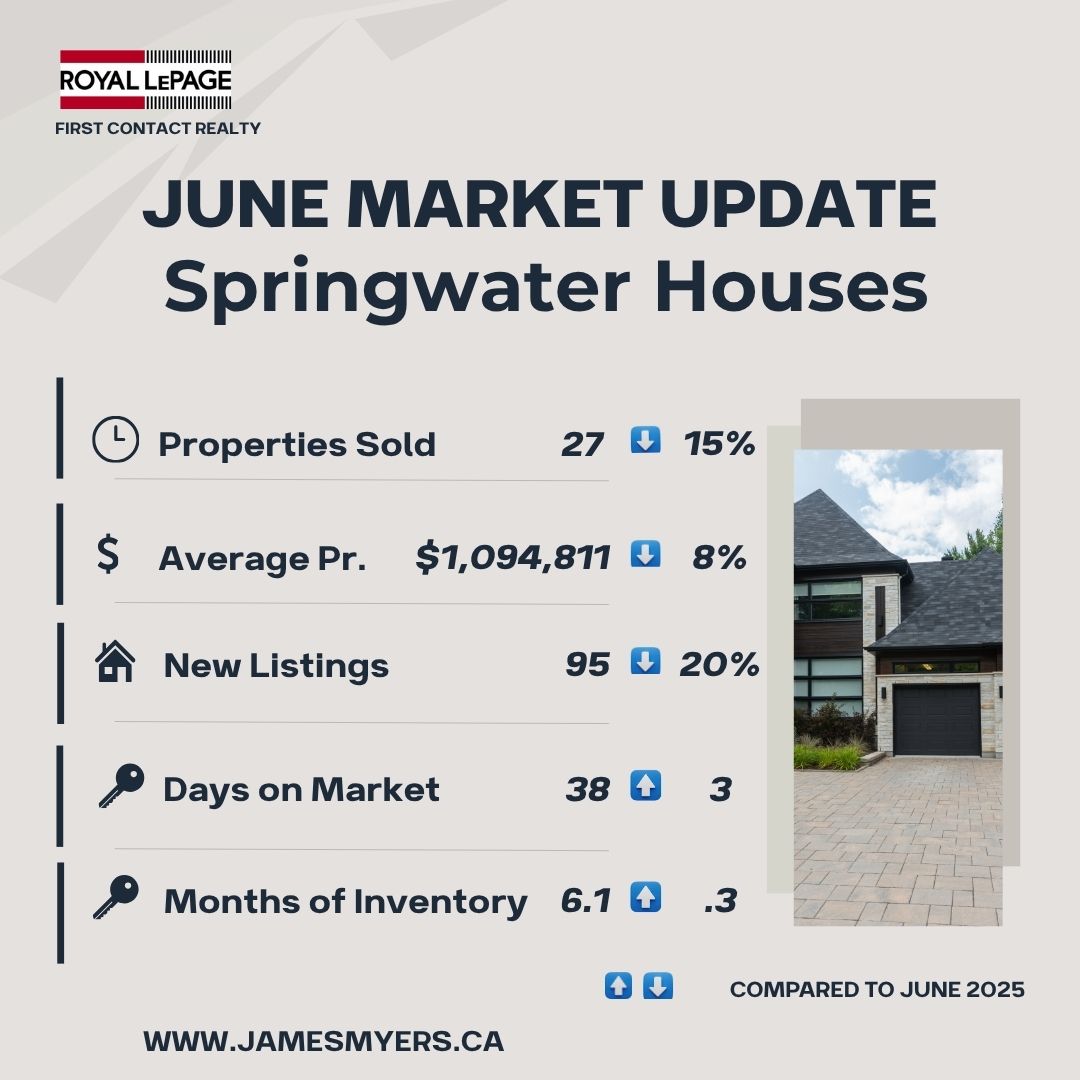
Springwater had a slower June compared to a year ago. Sales were down 15%, while the average sale price declined by 8%. New listings were also down 20%, so fewer buyers and fewer sellers were active in the market this year.
With 6.1 months of inventory, Springwater remains just outside of balanced market territory, and buyers continue to have plenty of choice and sellers need to be realistic with their pricing to attract serious interest.
Looking Beyond Average Prices
Average sale prices don't always tell the complete story. If more luxury homes sell during a particular month, the average price naturally rises. Conversely, if more entry-level homes sell, the average can decline even though overall market conditions haven't changed significantly.
That's why it's important to consider sales activity, inventory levels and days on market together. Looking at all of these indicators provides a much clearer understanding of where the market is heading than focusing on average price alone.
Final Thoughts
Overall, June presented a more encouraging picture of the local real estate market. Buyers are becoming more active, inventory has improved in many communities, and much of Simcoe County continues to move toward balanced market conditions.
Sellers still need to price their homes realistically, but well-presented and appropriately priced properties continue to attract strong interest.
If you're curious about what these statistics mean for your neighbourhood or would like to know the current value of your home, I'd be happy to help. Feel free to contact me anytime. You can also watch my full June 2026 Market Update video below for a more detailed breakdown of each community.
Most people moving to Barrie are focused on one thing—getting more house for their money. And that’s fair. But there are a few things about living here that don’t show up in the listings… and if you don’t know about them ahead of time, they can really catch you off guard. So in this post, I’m going to walk you through the five things you need to know before making the move to Barrie.
1. Winter is No Joke (Snow & Weather)
First up—winter. And I’m not talking about a little bit of snow here and there. Barrie gets hit with serious lake-effect snow coming off Georgian Bay, and it can pile up fast. If you’re coming from Toronto or the GTA, this is a different level. You’re going to be shoveling more, driving in snow more, and dealing with winter that tends to stick around longer than you might expect. It’s perfectly normal to still have snow on the ground in March… sometimes even into April. Now, if you like skiing or snowmobiling, this is a huge plus. But if you’re someone who dreads winter, this is something you really want to think about before making the move.
If you live in a house in Barrie (as opposed to a condominium) you will need a snow shovel at the very least. Better get two so you have a back up for when the first one breaks from over use. Depending on how big your driveway is and whether you have people in your house that are of shoveling age, you might consider getting a snowblower.
The roads in Barrie are not always clear of snow. Subdivisions are plowed to a lower standard than the main arterial roads. The street you live on could have hard packed snow on it for weeks and months at a time. This was quite common in the winter that just passed. And there are overnight parking restrictions during the winter. So if you have a lot of cars in your household, don’t buy a house with a small driveway.
“If you can’t handle winter… this might not be your place.”
2. You’ll Likely Need a Car
The second thing you need to know is—you’re going to need a car. Barrie does have public transit, and it’s run by Barrie Transit, but it’s not like living in a big city where you can rely on it for everything. Buses don’t come as frequently, routes are limited, and getting across the city or out of the city can take a long time. Most people here drive—it’s just part of daily life. So if you’re used to walking everywhere or hopping on a subway, that’s going to be a bit of an adjustment.
You may be able to get by with one car depending on your family dynamic. Does someone work from home? Can someone take transit or walk to their job? But if you have a family with 2 people heading out to work every day and kids in school that need to be picked up and delivered to various kid activities, you probably are going to need 2 cars. You can’t just say to your kids, Oh, just take the bus. It doesn’t work that way in Barrie.
Although, this being said, if you use Uber a lot and are used to it, it is available here in Barrie.
“Barrie is not Toronto—you can’t rely on transit.”
3. Commuting to the GTA (Highway 400 Reality)
Number three is commuting. Highway 400 is the black ribbon of asphalt that connects Barrie to Toronto. When the traffic is really light (very rarely these days) you can make it from Barrie to Toronto in about an hour. I don’t know when these mysterious light traffic times are. Maybe at 3:00 in the morning. But I haven’t seen 3:00 am in years. I have driven down there at various times of the day and it seems like it is always busy. Not bumper to bumper, not stop and go, but just cars everywhere. On weekday mornings headed southbound, it tends to bunch up approaching Highway 9 but since the 400 has been widened to 5 lanes with an HOV lane south of number 9, it picks up past there. And the opposite happens in the afternoon when people are coming home from work. Commuting times can vary widely from an hour to up to two hours depending on what time you are travelling and where you are going. Throw winter weather into the mix and the gameplan changes.
We also get the weekend cottage traffic on Highway 400. Friday afternoon and Sunday night are the worst. All the cottagers are racing to get up north. And I get it, if I had a cottage I’d want to race up to it too. We here in Barrie have learned that there are certain times on the weekend you just don't go anywhere near the highway.
Throw winter weather into the mix and everything changes.
So if you’re planning to commute, just understand—it’s not always a smooth or predictable drive.
4. Housing Types & Affordability
Number four is housing. This is one of the big reasons people look at Barrie in the first place. You generally get more house for your money compared to the GTA. There’s a good mix of detached homes, townhomes, and newer subdivisions, especially in the south end.
Barrie is a city built on the detached house. The most common of these are the 3 and 4 bedroom, 2 storey detached models. There are thousands of houses like this built in many different areas over the years. BUT: they are not cheap anymore. (is anywhere in Ontario cheap?) Bottom line: you will get a bigger bang for your buck in Barrie, but it is not the bargain place it once was. An average 3 bedroom detached 2 story house is going to set you back around $700,000 and a 4 bedroom will be around $850,000.
While prices have gone up quite a bit over the years, it’s still way more affordable than Toronto. Another thing to keep in mind is that condos are not as common here as they are in bigger cities, so your options might be a bit more limited if that’s what you’re looking for. As housing everywhere gets more expensive, Barrie is starting to build more condominiums. Overall, though, for many people, Barrie still offers good value—especially if space is important to you.
More house for your money… but not cheap anymore.
5. Lifestyle: Slower Pace with Nature Nearby
And number five is lifestyle—and this is where Barrie really shines. You’re right on Kempenfelt Bay. You’ve got easy access to beaches, trails, and boating, without having to plan your whole day around it. On a nice evening, you can head down to the waterfront, go for a walk, grab an ice cream, and it actually feels relaxed. No matter where you live in Barrie, you are never more than 15 minutes away from the waterfront. And it’s not just summer. In the winter, you’re a short drive from skiing and snowboarding. You can buy a weeknight ski pass for Snow Valley and go hit the slopes for a couple of hours after work.
Even day-to-day, there’s more space, less noise, and a slower pace overall. You’re not constantly rushing or dealing with the same level of congestion and pressure that comes with living in the GTA.
But that comes with a bit of a trade-off. You’re not going to have the same level of convenience or variety that you’d get in a larger city. There are fewer restaurants, less nightlife, and not as many options when it comes to shopping or entertainment. If you’re used to having everything at your fingertips at all hours, that adjustment can take some time. A lot of people still find themselves heading down to the GTA for concerts, major events, or even just a wider selection of dining options.
So really, it comes down to what matters more to you. If you value space, nature, and a slower, more relaxed way of living, Barrie can be a fantastic fit. But if convenience, variety, and big-city energy are high on your list, that’s something you’ll want to think carefully about before making the move.
You’re trading convenience for lifestyle.
So if you’re considering a move and want to make the right decision, check out this video right here—it’ll help you decide if Barrie is the right fit. And if you’ve got questions about Barrie or the surrounding area, feel free to reach out—I’m always happy to help.
The latest real estate statistics suggest that the declining housing market we've experienced over the past few years may finally be stabilizing.
While average home prices in Barrie, Innisfil, and Simcoe County remain lower than they were a year ago, many areas are showing modest price increases compared to February, March, and April of this year. Sales activity is also improving, with more homes changing hands than last year while the number of new listings has decreased.
In this month's market update, I look at Barrie, Innisfil, Simcoe County, and two additional communities that are attracting a lot of attention: Springwater and Oro-Medonte. These desirable areas north of Barrie include sought-after neighbourhoods such as Midhurst, Snow Valley, Horseshoe Valley, and waterfront communities along Lake Simcoe. In some of these areas, average sale prices are actually higher than they were a year ago.
The market remains balanced overall, but conditions vary depending on location and property type. Detached homes and townhouses continue to perform well in many areas, while the condominium market remains more challenging.
The general trend I'm seeing is that prices are stabilizing, sales volume is increasing, and the number of homes available for sale is gradually declining. While every market segment behaves differently, the data suggests that confidence is returning and the market is finding its footing.
If you're considering buying or selling in Barrie, Innisfil, Springwater, Oro-Medonte, or anywhere in Simcoe County, I'd be happy to discuss what these trends mean for your specific situation.
I have listed a new property at 14 Frederick Street in Barrie. See details here
Step into the charm and character of this beautifully maintained 3-bedroom century home, where timeless appeal meets everyday practicality. Spotless and full of warmth, this home has been lovingly cared for and is move-in ready. From the moment you walk in, you'll appreciate the clean, inviting feel and the character that only a true century home can offer. Many recent updates such as furnace in 2021, Appliances in 2023, shingles in 2025, water heater 2022. A standout feature is the spacious 2-car garage, complete with a mechanic's pit - perfect for car enthusiasts. Conveniently located within walking distance to the Barrie Allandale GO Station, this home is ideal for commuters while still offering the comfort and charm of a mature neighbourhood setting. Whether you're looking for character, functionality, or location, this property offers a unique opportunity to own a truly special home.
April numbers are out, and the spring market is finally starting to wake up across the GTA and here in Simcoe County.
Sales were actually UP in April compared to last year, while the number of new listings coming onto the market dropped. And that’s important because it tells us the market may slowly be tightening.
Now here’s the interesting part…
Even though more buyers are entering the market, prices are still lower than they were a year ago. In Simcoe County overall, the average price is down around 6% year over year. Buyers still have negotiating power. They still have choices and conditions within offers are the norm again. They can be more selective. Buyers, you have the time when searching for a house. Use it.
But, that being said, if you have been looking for a house and haven’t seen anything that checks all your boxes then all of a sudden something comes along that makes your heart skip a beat, be ready to strike. Because if you love a house, there is a good chance that the next buyer through may love it too.
But sellers with properly priced homes are absolutely still selling. The unrealistically priced listings are sitting. The good listings are moving.
Buyers still have leverage… But that could change in a heartbeat and the shoe would be on the other foot again. We saw that in 2020-2021 when prices took off overnight. Things could be different six months from now.”
If you've been thinking about buying a new home in Ontario, the province just announced something that could save you tens of thousands of dollars — and this time, it applies to everyone, not just first-time buyers.
I'm going to walk you through everything you need to know about Ontario's newly expanded HST rebate on new homes — what it is, who qualifies, how much you could save, and how long this window is open.
The Ontario government has been working to tackle the housing crisis for a few years now. Back in 2023, they introduced an HST rebate specifically for purpose-built rental housing — and it worked. Rental housing starts climbed from around 18,000 to nearly 24,000 by 2025.
Then, just a few months ago in the fall of 2025, they introduced an HST break for first-time home buyers on homes under a million dollars. But that program didn't move the needle the way they hoped. Sales were sluggish, and new construction projections for 2026 were falling — partly because of economic uncertainty and the impact of U.S. tariffs making everything more expensive.
So the province went back to the drawing board. And what they came up with is much bigger — a temporary but sweeping rebate that removes the HST for all buyers of new homes across Ontario.
What Is the Rebate?
Here's the core of the program. Ontario, working together with the federal government, is proposing to eliminate the full 13% HST on qualifying new homes. That means both the provincial 8% portion and the federal 5% portion would be rebated back to buyers — subject to federal regulatory approval.
And the rebates are structured based on the purchase price of the home:
Homes up to $1 million: You could receive a rebate of up to $130,000 — the full 13% HST. This is the maximum amount available and applies to the broadest range of buyers.
Homes between $1 million and $1.5 million: The same maximum rebate of $130,000 is maintained. This was specifically designed to reflect the reality of housing costs in many Ontario communities where $1 million doesn't buy nearly as much as it used to.
Homes between $1.5 million and $1.85 million: A reduced, sliding-scale rebate applies. So you'll still get meaningful savings, just not the full amount.
Homes above $1.85 million: These will qualify for $24,000 in HST relief under the pre-existing rebate rules — so there's still some benefit, just not the expanded amount.
Who Qualifies?
Now, who is actually eligible? This is where it's important to pay close attention to the dates.
The program is open to any buyer — not just first-timers — as long as the home will be used as either a primary residence or as a residential rental property.
The fact that this applies to all buyers and not just first timers is important. If a person bought a starter home a few years ago and now needs to move up to a bigger home because of family changes, this program will help them do that which will in turn free up their starter home for the next first time buyer.
There are two main eligibility scenarios:
Scenario 1 — Primary Residence Purchase: The purchase agreement with your builder must be signed between April 1, 2026 and March 31, 2027. Construction of the home must begin on or before December 31, 2028, and construction must be substantially completed by December 31, 2031.
Scenario 2 — Rental Property (Construction Already Underway): If a home was already under construction before March 31, 2026 and will be used as a rental, the purchase agreement still needs to be signed between April 1, 2026 and March 31, 2027 — and construction must be substantially completed by December 31, 2029.
How Does This Compare to the Old Rules?
The government included a chart in their briefing document that really puts this into perspective visually, and I want to walk you through it.
Under the old rules, the rebate was quite limited. For most homes above a certain price threshold, buyers were only getting around $24,000 back — and nothing for more expensive homes.
Under the new program, the jump is dramatic. A $700,000 home now qualifies for a rebate of approximately $91,000. A $1.2 million home gets the full $130,000. A $1.7 million home still gets back roughly $69,500.
That is a significant amount of money back in buyers' pockets — money that could go toward your down payment, mortgage payments, renovations, or just your financial security.
How Long Does This Last? Could It Be Extended?
Right now, the program is designed to run for one year — from April 1, 2026 to March 31, 2027. That's the window in which your purchase agreement needs to be signed to qualify.
The one-year timeframe was actually a deliberate choice. According to reporting from Global News, the province debated a longer three-year window but was concerned that buyers would simply wait on the sidelines, taking away the urgency that makes this kind of stimulus work. A one-year deadline creates immediate demand.
That said, the government hasn't closed the door on extending it. Premier Ford himself suggested people should wait to see how things unfold. And the province's own projections suggest the program could stimulate an additional 8,000 housing starts and support up to 21,000 jobs, boosting Ontario's real GDP by approximately $2.7 billion. If those numbers come true, you can bet there will be serious conversation about extending the program beyond March 2027.
So while it's a one-year program for now, watch this space.
A couple of things to keep in mind:
First, this program is a proposal that requires federal regulatory changes to fully take effect. The federal government has agreed in principle to cost-share with Ontario, but the legislation still needs to pass.
Second, the HST and its rebates are administered by the Canada Revenue Agency — so the actual rebate process goes through the CRA, not the province directly. Talk to your builder and your accountant about how to claim it.
And third, the province has said municipalities should also be doing their part by reducing development charges — fees that can add hundreds of thousands of dollars to the price of new homes. So this provincial rebate is one piece of a larger affordability puzzle.
Bottom line: if you've been sitting on the fence about buying a new home in Ontario, this is a significant incentive to act. Whether you're a first-time buyer or someone looking to move up, upsize, or invest in a rental property — the savings under this program are real and substantial.
The window opens April 1st, 2026 and runs for one year. So the clock is already ticking.
As always, I'd strongly encourage you to speak with a qualified real estate agent, mortgage broker, or tax professional to understand how this applies to your specific situation.
How Much Does It Really Cost to Live in Barrie in 2026?
How much money do you actually need to live comfortably in Barrie in 2026? Is it really that much cheaper than Toronto? And where does your money actually go every month? Let's break it down.
This video is especially helpful if you're moving from the GTA, downsizing, or trying to decide whether Barrie makes financial sense compared to where you live now.
Why Barrie?
Barrie sits about an hour north of Toronto, connected directly by Highway 400 — which is currently being widened from three lanes to five. It's already five lanes up to Highway 9 in Newmarket, and the work is ongoing. Most of the bridges have already been rebuilt to accommodate five lanes, so realistically this could be fully done within a few years. That's going to make the commute noticeably easier — and if you're thinking long-term, buying before that happens might be a smart move.
One of the biggest reasons people relocate here? Housing. It costs significantly less than Toronto — and the gap is bigger than most people realize.
Continued Below…..
Renting
If you want to test the waters before buying, renting in Barrie is a reasonable option. In fact, Barrie used to rank among the top five most expensive rental markets in Canada — but that's changed. It didn't even crack the top ten most expensive in 2025.
Right now you can rent a decent three-bedroom house for around $2,200–$2,500 a month. A four-bedroom will cost a little more. A two-bedroom condo starts in the low $2,000s. Compare that to Toronto where a two-bedroom condo regularly runs $2,800–$3,000+, and you're already saving hundreds every single month just on rent.
House Prices
The average detached house in Barrie is around $770,000. In Toronto? Well over $1.5 million. That's not a small difference — that's life-changing.
Let's put it in real mortgage terms. On a $770,000 home with 20% down at current rates, you're looking at a monthly mortgage payment in the roughly $3,300–$3,600 range depending on your rate and amortization. On a $1.5M Toronto home with the same down payment? You could easily be at $6,700–$7,000 a month. That's a difference of $3,400 every single month — money that stays in your pocket.
Condos tell a similar story: about $520,000 in Barrie versus $632,000 in Toronto — and Barrie condos are generally newer and larger for the price.
Property taxes on that average detached home run about $5,500 a year here, compared to around $7,500 in Toronto.
Transit
Barrie's transit system has been expanding. A monthly adult pass is $93, a student pass is $71, and a single fare is $3.50. It's not Toronto's TTC, but for getting around the city, it does the job. The city has been actively improving routes, so this is an area to watch.
Groceries
Groceries in Barrie are comparable to the GTA — you're not going to save dramatically at the checkout. A four-litre bag of milk runs about $6.50, a dozen eggs around $5.00, and a can of Maxwell House coffee about $20. Produce and meat fluctuate too much to quote, but expect similar pricing to what you're used to in the GTA.
Where you will save is on the stress of getting to the store. You're not stuck in traffic for 40 minutes just to get to a Loblaws.
Getting to Work — Commuting
If you're working in Toronto and driving every day, commuting costs are real. Budget at least $25 a day in fuel for a Toronto round trip. Gas in Barrie ranges from about $1.20 a litre at Costco up to $1.35 at other stations — and prices can vary by as much as 10 cents per litre between the south end and the north end of the city. Pro tip: Costco is almost always the cheapest, and prices are lowest at night. Also, factor in added wear and tear and maintenance on your car.
The good news? A lot of Barrie residents who used to commute daily have shifted to hybrid or remote work schedules. If you're going in two or three days a week instead of five, that commuting cost drops dramatically — and the Barrie lifestyle math starts looking very, very good.
Gym Memberships
There are solid options at every price point. Planet Fitness advertises around $15 a month, Fit 4 Less is around $20, and LA Fitness runs about $45. On the premium end, places like Athletic Kulture and the newer Pure Athletic Club cab be $100+. The City of Barrie also runs recreation centres with family memberships at reasonable rates.
My advice: don't join a gym that's 30 minutes from your house just because it is cheap. Any money you save on the membership, you'll lose in gas and time.
Internet & TV
Most areas of Barrie have access to top-tier internet — Bell Fibe and Rogers Xfinity both service the city. Bundle pricing with TV and phone varies quite a bit, but expect to pay roughly $60–$130 a month depending on what you bundle and how well you negotiate. And yes — always call to negotiate. Both providers will almost always come down from their advertised rates.
Kids' Activities
This one matters a lot for families. Here's what things look like for seasonal fees:
Barrie Minor Hockey: $650–$750 depending on age and when you register. Early bird discounts are available.
Barrie Royals Basketball : Pricing wasn't listed on their website when I checked, but they've been a staple program here for years — worth calling directly.
Baseball: $250–$400+ depending on age.
Soccer: Around $250.
Outdoor summer sports are noticeably cheaper than winter sports — maintaining a soccer field costs a lot less than running an ice rink. If your kids play hockey, there is equipment to buy, so just factor that into your monthly budget from the start. That stuff can get expensive.
Taxes — The HST
For anyone watching from outside Ontario: we have the Harmonized Sales Tax, which combines the provincial Sales Tax at 8% and federal Goods and Services Tax 5% for a total of 13% on most purchases. Groceries from a grocery store are exempt. Everything else — pretty much expect to add 13%.
So What's the Bottom Line?
Let's say you're a family of four, buying an average detached home in Barrie. Rough monthly picture:
Mortgage: ~$3,300–$3,600
Property taxes: ~$450/month
Groceries: ~$1,000–$1,200
Internet/phone/TV bundle: ~$130
Gas (local driving): ~$200–$300
A couple of kids in sports: $200
Gym membership (mid-range): ~$45
You're looking at roughly $5,300–$5,900 a month for core expenses — before entertainment, clothing, eating out, or savings. That same lifestyle in Toronto would be closer to $9,000+ a month.
That gap is real money. Year over year, it's the difference between building equity and financial breathing room — or constantly feeling stretched.
Thinking About Making the Move?
If you're seriously considering Barrie, I'd love to help you figure out if it makes sense for your situation. Even if you're just in the early research stage, feel free to reach out — no pressure, just a conversation.
In this video I break down what happened in the local housing market during February, including Barrie, Innisfil and other parts of Simcoe County.
Overall, home prices were down in most areas compared to February of last year, with many markets seeing declines in the 8–13% range. Sales activity was also lower in many areas.
One interesting exception was Innisfil, where prices were actually up about 1% year over year and the number of sales remained steady.
If you are a homeowner wondering what these changes might mean for the value of your home, I’d be happy to help.
With over 25 years of experience selling homes in Barrie and the surrounding communities, I work with homeowners throughout Barrie, Innisfil, Essa, Oro-Medonte and Springwater.
If you are thinking about selling and would like to know what your home might be worth in today’s market, feel free to reach out anytime.
This website may only be used by consumers that have a bona fide interest in the purchase, sale, or lease of real estate of the type being offered via the website.
The data relating to real estate on this website comes in part from the MLS® Reciprocity program of the PropTx MLS®. The data is deemed reliable but is not guaranteed to be accurate.